

Self-Installed Medical Alert Systems for Manufacturing Facilities
Yes, there is a medical alert system for manufacturing facilities that can be self-installed. RapidAlert by BluePoint Alert Solutions is engineered specifically for EHS and occupational safety teams to deploy without professional contractors. This guide covers wearable panic buttons, wireless coverage, fall detection, and cellular connectivity to help you build a robust safety net.
Wearable Panic Buttons
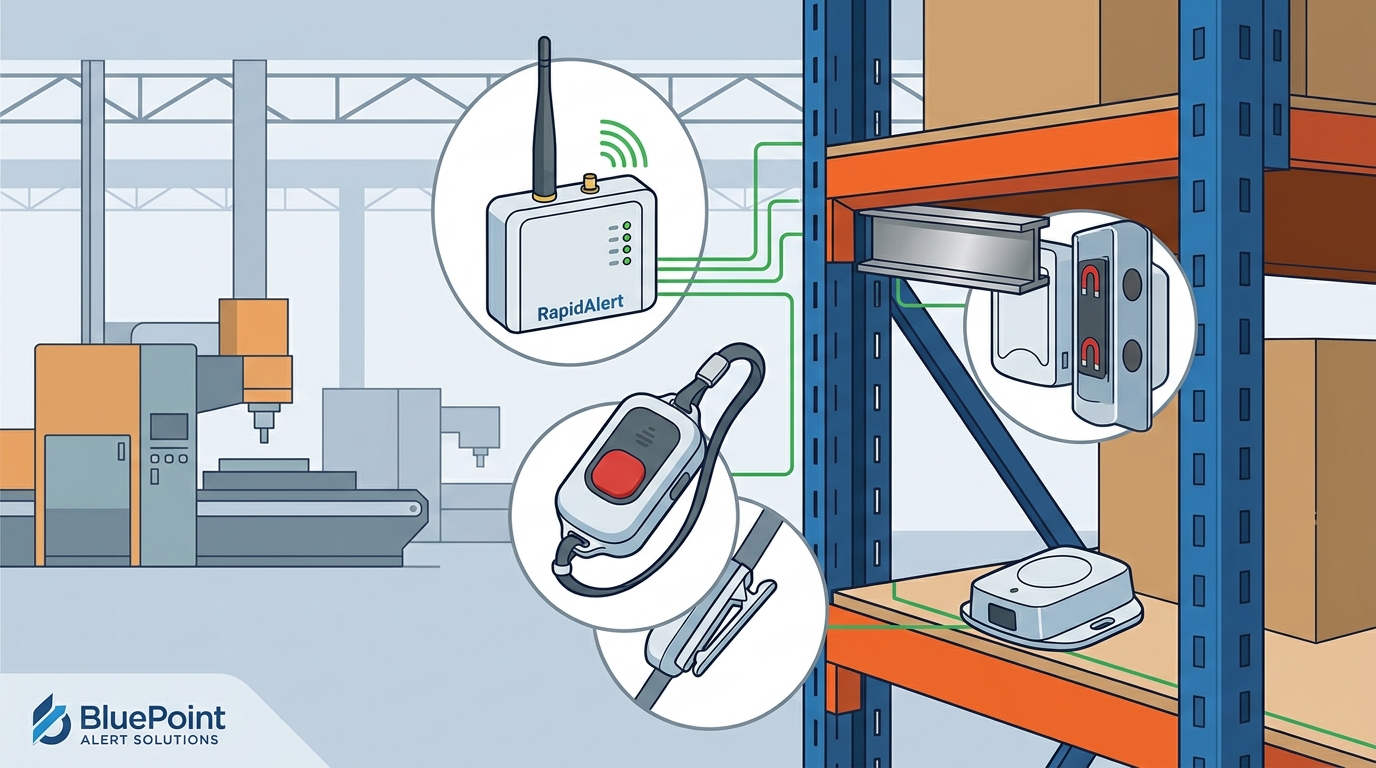
Wearable panic buttons are portable activation devices that allow employees to trigger an emergency alert from anywhere on the factory floor. In manufacturing environments, fixed pull stations are often too far from the point of injury. A worker who collapses near a heavy press or in a remote warehouse aisle cannot physically reach a wall-mounted device. Wearable pendants solve this mobility gap by keeping the activation mechanism on the person.
Integration with Command and Control
When a wearable device is activated, it communicates directly with the Command and Control platform. This integration ensures that the alert includes precise location data and incident context. The system does not just send a generic alarm; it orchestrates a coordinated response by notifying the right people simultaneously. This reduces the confusion that often delays medical aid in large industrial spaces.
Design for High-Stress Scenarios
BluePoint designs its activation interfaces to be simple and intuitive, modeled after familiar fire alarm pull stations. Users do not need extensive training to operate them. In a high-stress medical emergency, cognitive load is high. A simple push-and-pull mechanism ensures that even a distressed employee or a bystander can activate the system effectively. This design philosophy is critical for manufacturing floors where noise and chaos can obscure complex instructions.
Wireless Manufacturing Coverage
Wireless manufacturing coverage refers to the ability of an alert system to transmit signals reliably across large, open industrial spaces without relying on wired infrastructure. Manufacturing facilities often span hundreds of thousands of square feet with high ceilings and metal structures that can interfere with standard Wi-Fi or radio signals. A self-installed system must account for these physical challenges to ensure that an alert from one end of the building reaches the central station without delay.
Overcoming Signal Interference
Industrial environments are filled with electromagnetic noise from machinery, HVAC systems, and metal framing. Traditional wireless systems may struggle in these conditions. BluePoint systems utilize redundant communication pathways to mitigate this risk. By using cellular technology as a primary or backup channel, the system ensures that alerts are transmitted even if local wireless networks are congested or down. This redundancy is a core component of the life-safety approach used in the Medical Alert system.
Strategic Device Placement
Effective coverage requires strategic placement of both fixed and wearable devices. Fixed pull stations should be located in high-risk areas such as production lines, loading docks, and break rooms. Wearable devices provide mobile coverage for workers who move between these zones. The Industrial Alert solution emphasizes placing medical pull stations in areas of worker concentration to maximize the probability of a rapid response. This layered approach ensures that no part of the facility is a dead zone for emergency communication.
Fall Detection
Fall detection is a feature that automatically identifies when a person has fallen and triggers an alert without requiring manual activation. In manufacturing, falls from height or slips on wet floors are significant risks. A worker who loses consciousness after a fall cannot press a button. Automated fall detection bridges this gap by using sensors to recognize the impact and subsequent lack of movement. This technology is essential for protecting workers in isolated areas where help might not arrive quickly.
Automated Response Protocols
When a fall is detected, the system initiates a predefined response protocol. This typically includes sending an immediate alert to on-site medical responders and, if configured, to local emergency services. The RapidAlert platform supports these automated workflows, ensuring that the response is consistent and immediate. The system can also provide real-time location tracking, allowing responders to find the fallen worker quickly. This capability is particularly valuable in large warehouses where searching for a specific individual can be time-consuming.
Complementing Manual Alerts
Fall detection works best when combined with manual activation options. Some falls may not be detected by sensors due to the angle of impact or the presence of protective gear. Therefore, wearable panic buttons remain a critical component of the safety ecosystem. The combination of automated detection and manual activation provides a comprehensive safety net. This dual approach ensures that whether a worker is conscious and able to act, or unconscious and unable to act, an alert is sent.
Cellular Connectivity
Cellular connectivity is the use of mobile network infrastructure to transmit emergency alerts from on-site devices to a central monitoring station. For self-installed systems, cellular connectivity is often the preferred method because it eliminates the need for complex wired network configurations. It provides a direct, reliable link to the monitoring center, ensuring that alerts are received even if the facility's internal IT network is compromised or offline.
Redundancy and Reliability
BluePoint systems are designed with redundancy in mind. The Integrity and Privacy documentation highlights the use of multiple carriers and independent connections to the internet. This multi-homed approach ensures that the loss of any single carrier has no effect on service. Communication systems are rated for high availability, with minimal downtime per year. This level of reliability is critical for life-safety applications where a missed alert can have fatal consequences.
Self-Installation Simplicity
Cellular connectivity simplifies the self-installation process significantly. Instead of running Ethernet cables or configuring Wi-Fi access points, installers can simply plug in a device and insert a SIM card. The RapidAlert units feature plug-in transformers for standard duplex receptacles and supervised battery backups. This design allows EHS teams to install devices quickly and easily, without requiring specialized IT support. The system is supervised for communication trouble, alerting administrators if the cellular connection is lost.
Comparison of Connectivity Options
| Feature | Cellular | Wired Ethernet | Wi-Fi |
|---|---|---|---|
| Installation Complexity | Low | High | Medium |
| Reliability in Industrial Environments | High | High | Variable |
| Dependency on Facility IT | Low | High | High |
| Best For | Self-Installation | Fixed Infrastructure | Short-Range Coverage |
Key Takeaways
- Self-installed medical alert systems like RapidAlert are specifically designed for EHS teams to deploy without professional contractors.
- Wearable panic buttons provide mobile activation capabilities, crucial for workers moving across large manufacturing floors.
- Wireless coverage must account for industrial signal interference, often requiring redundant communication pathways.
- Fall detection technology automatically triggers alerts when a worker is unconscious, bridging the gap when manual activation is impossible.
- Cellular connectivity offers the simplest installation path, eliminating the need for complex wired network configurations.
- Redundant communication systems ensure high availability and reliability, critical for life-safety applications.
- Strategic placement of both fixed and wearable devices ensures comprehensive coverage across the entire facility.
- The Command and Control platform orchestrates coordinated responses, reducing confusion and speeding up medical aid.
Frequently Asked Questions
Can EHS teams install BluePoint systems themselves?
Yes, RapidAlert is designed for self-installation by EHS and occupational safety teams. The units are easy to install and manage, requiring no professional contractors for standard setups.
How does the system handle signal interference in manufacturing plants?
The system uses redundant communication pathways, including cellular failover, to ensure alerts are transmitted even if the primary network fails or is interfered with by industrial equipment.
Is fall detection included in the medical alert system?
While specific fall detection features may vary by configuration, the system is designed to handle medical emergencies where workers may be unable to activate devices manually. Automated workflows ensure a response is triggered.
What happens when a wearable panic button is activated?
Activation triggers immediate alerts to designated medical responders via the Command and Control platform. Notifications include exact location information and are sent via text, call, and email.
Does the system require a smartphone app to function?
No, the system does not require a phone app or software for basic alert transmission. Automated text, email, and voice communications reach the response team instantly without needing a login.
How reliable is the cellular connectivity for emergency alerts?
Communication systems are rated at 99.999% availability with less than 5 minutes of downtime per year. Multiple carriers provide independent connections to ensure reliability.
Can the system be integrated with existing security cameras?
Yes, the Command and Control platform can provide live security camera links to authorized individuals during an emergency, enhancing situational awareness for responders.
Is the system ADA compliant?
Yes, devices are designed with accessibility in mind, including proper mounting heights, tactile feedback, and visual indicators to meet ADA requirements where applicable.
Conclusion
Manufacturing facilities face unique safety challenges that require robust, reliable, and easy-to-deploy emergency response solutions. BluePoint Alert Solutions provides a self-installed medical alert system that addresses these needs with wearable panic buttons, wireless coverage, fall detection, and cellular connectivity. By leveraging the RapidAlert platform, EHS teams can empower their workforce with the tools to respond faster and save lives. To explore how these solutions can fit your facility, for a personalized consultation.