

Medical Alert Systems for EHS Teams: A Guide to Fire Alarm Independence
Yes, a dedicated medical alert system for EHS teams exists and operates entirely separately from the building fire alarm. BluePoint Alert Solutions provides the RapidAlert platform, a self-installed, cellular-based system that notifies designated medical responders without triggering building-wide evacuation protocols. This guide covers how independent medical systems function, the specific benefits for EHS teams, and how wearable devices integrate with modern emergency response infrastructure.
Why Separation from Fire Alarms Matters
Traditional emergency infrastructure often conflates medical emergencies with structural threats. A fire alarm is a mass notification system designed to evacuate a building. When a medical event, such as a cardiac arrest or severe allergic reaction, triggers a fire alarm, it creates unnecessary panic and disrupts operations. Medical alert separation is the architectural practice of isolating health-related notifications from life-safety evacuation protocols.
The Cost of Conflation
Every minute lost during a cardiac arrest reduces survival rates by up to 10%. If a facility relies on a fire alarm to notify staff of a medical event, the response is delayed by the time it takes to verify the alarm and initiate evacuation. This delay is critical. EHS teams need a system that alerts the right people immediately without disturbing the entire facility. Independent systems ensure that operations continue unhindered while medical responders are dispatched to the exact location of the incident.
Operational Continuity
In industrial and corporate environments, stopping production for a medical alert is costly. A dedicated medical alert system allows for targeted notification. Only the designated medical response team and necessary administrators receive the alert. This precision prevents the chaos associated with building-wide strobes and audio messaging, which are reserved for active threats or fire events. By keeping these systems separate, organizations maintain a calm environment while addressing urgent health needs.
The RapidAlert Platform for EHS Teams
BluePoint Alert Solutions has engineered the RapidAlert system specifically to bridge the gap in workplace medical response. This platform is designed for EHS and occupational safety teams who need instant, interactive alerts. It is a self-installed solution that requires no complex integration with existing fire alarm panels. The system is built to be ready when you need it, providing a lifeline for employees in high-risk areas.
Instant and Interactive Alerts
RapidAlert delivers instant alerts via text, call, and notifications within seconds of activation. The system includes exact location information, ensuring responders know precisely where to go. Unlike static alarms, RapidAlert is interactive. It allows for real-time communication between the person in distress, the EHS team, and on-site responders. This two-way communication drives action and clarity, eliminating the guesswork that often plagues emergency situations.
Self-Installation and Management
One of the primary advantages of the RapidAlert platform is its ease of deployment. It is designed for EHS teams to install and manage without relying on external security integrators for every change. The device uses a plug-in transformer for standard duplex receptacles and includes an integral battery backup. This ensures uninterrupted service during power outages. The system is supervised for AC loss and low battery, providing peace of mind that the device is always operational.
Cellular Communication
RapidAlert utilizes a cellular dual SIM primary communication pathway. This redundancy ensures that alerts are transmitted even if the building's local network fails. An optional wired ethernet connection is also available for facilities that prefer a hardwired backup. This robust communication architecture is critical for reliability, as it guarantees that the alert reaches the response team regardless of local infrastructure issues.
Wearable Panic Buttons and Mobile Activation
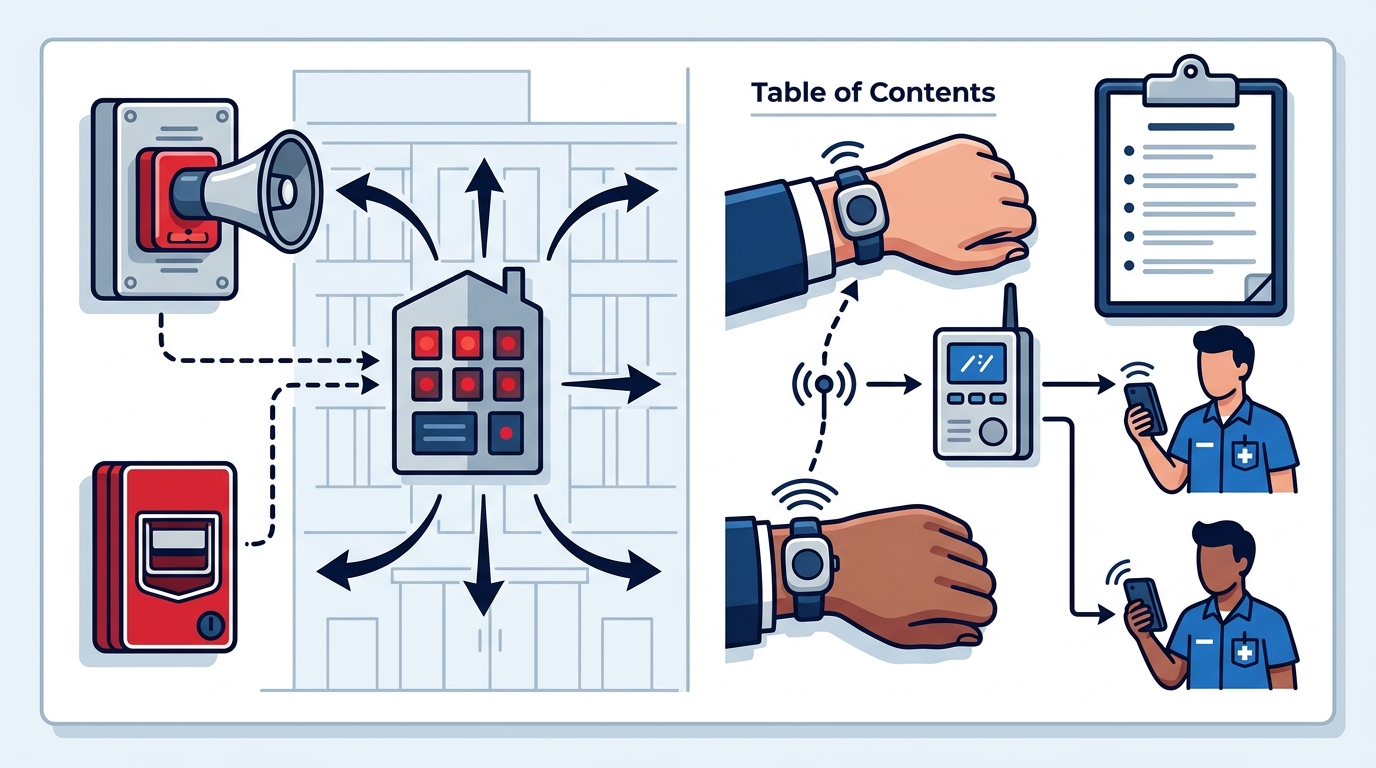
Fixed pull stations are effective, but they require the user to be near the device. In large facilities, such as warehouses or manufacturing floors, an employee may be far from a fixed station when an emergency occurs. Wearable panic buttons are portable activation devices that allow individuals to trigger an alert from anywhere within the facility. These devices are essential for mobile staff, security personnel, and visitors who need immediate assistance.
Portability and Accessibility
BluePoint systems include wearable mobile pendants that act as portable panic buttons. These devices enable individuals moving around the building to activate the system quickly and securely. For EHS teams, this means that a worker in a remote section of a plant can trigger a medical alert without walking to a fixed station. The wearable device transmits the alert with the same precision and speed as a wall-mounted unit. This capability significantly reduces response time in large or dispersed work environments.
Integration with Fixed Systems
Wearable devices are not standalone; they integrate seamlessly with the central Command & Control platform. When a wearable is activated, it triggers the same automated notifications and interactive communication channels as a fixed pull station. This integration ensures that the response protocol remains consistent, regardless of how the alert is initiated. EHS teams can issue these devices to key personnel, ensuring that help is always within reach, even in areas where fixed stations are impractical.
Coordinated Response and Situational Awareness
Notification is only the first step in an effective emergency response. Coordination is what turns an alert into a successful outcome. BluePoint's Command & Control (C2) platform orchestrates the entire response process. It provides real-time situational awareness through live maps and floor plans. This visual intelligence gives every responder, both on-site and inbound, a common operating picture of the incident.
Live Mapping and Floor Plans
The C2 platform displays the facility layout with pertinent information for informed decisions. When a RapidAlert device is activated, the exact location is marked on the digital floor plan. This allows responders to navigate to the incident site efficiently. In complex buildings with multiple floors or wings, this feature is invaluable. It eliminates the time spent searching for the victim and allows responders to arrive with context, not just an alarm signal.
PSAP Dispatch Integration
RapidAlert units can be configured to make a dispatch request to the local Public Safety Answering Point (PSAP). This ensures that professional emergency medical services are notified with precise location and incident context from the moment of activation. This optional feature bridges the gap between on-site response and professional EMS. It ensures that if the on-site team is overwhelmed or if the situation is severe, outside help is already en route. This integration is critical for facilities that may not have full-time paramedics on staff.
Implementation and Maintenance Best Practices
Deploying a medical alert system requires careful planning to ensure maximum coverage and reliability. EHS teams should conduct a risk assessment to identify high-risk areas. These areas, such as lunch areas, manufacturing production zones, gyms, and nurse offices, should be prioritized for device placement. Strategic placement ensures that no employee is more than a short distance from an activation point.
Device Placement Strategy
Fixed pull stations should be located in areas with a higher risk of medical emergencies. This includes high-occupancy zones and areas where physical exertion is common. Wearable devices should be issued to staff who move throughout the facility, such as security guards, maintenance workers, and supervisors. By combining fixed and mobile activation points, organizations create a comprehensive safety net. This approach ensures that help is available regardless of where an incident occurs.
Testing and Maintenance
Regular testing is essential to ensure system functionality. BluePoint recommends testing devices at least quarterly. This includes verifying that the device transmits an alert, that the notification reaches the designated contacts, and that the battery backup is functioning. EHS teams should maintain a log of all tests and any maintenance performed. This documentation is crucial for compliance and for identifying potential issues before they become critical failures. Consistent maintenance ensures that the system is ready when it is needed most.
Key Takeaways
- Medical alert systems should be separate from fire alarms to prevent unnecessary evacuations and maintain operational continuity.
- BluePoint's RapidAlert platform is a self-installed, cellular-based system designed specifically for EHS teams.
- Wearable panic buttons provide mobile activation capabilities, ensuring help is available in large or dispersed facilities.
- The Command & Control platform offers real-time situational awareness through live maps and floor plans.
- Integration with PSAP dispatch ensures that professional EMS is notified with precise context.
- Strategic device placement in high-risk areas is critical for minimizing response time.
- Regular testing and maintenance are necessary to ensure system reliability and compliance.
Frequently Asked Questions
Is RapidAlert compatible with existing fire alarm systems?
RapidAlert is designed to operate independently of fire alarm systems. It does not require integration with fire alarm panels, which allows for easier installation and management. This independence ensures that medical alerts do not trigger building-wide evacuation protocols.
How does the wearable panic button work?
The wearable panic button is a portable device that transmits an alert via cellular communication. When activated, it sends a notification to the designated response team with the user's location. It integrates with the Command & Control platform, providing the same level of coordination as a fixed pull station.
Can RapidAlert notify professional EMS?
Yes, RapidAlert units can be configured to make a dispatch request to the local Public Safety Answering Point (PSAP). This ensures that professional emergency medical services are notified with precise location and incident context from the moment of activation.
What happens if the building network goes down?
RapidAlert uses a cellular dual SIM primary communication pathway. This ensures that alerts are transmitted even if the building's local network fails. An optional wired ethernet connection is also available for additional redundancy.
How often should the system be tested?
Regular testing is recommended at least quarterly to ensure device functionality, system reliability, and battery backup integrity. EHS teams should maintain a log of all tests and maintenance activities.
Is training required to activate the system?
No, the system is designed to be simple and intuitive. Activation is modeled after a standard fire alarm pull station, requiring a push-in and pull-down motion. This familiarity ensures that anyone can activate the system in a high-stress scenario without prior training.