

Medical Alert Systems for EHS Teams: A Guide to Fire Alarm Independence
Yes, a dedicated medical alert system for EHS teams exists and operates entirely separate from the building fire alarm. BluePoint Alert Solutions provides the RapidAlert platform, which delivers instant, interactive medical alerts without triggering building-wide evacuation protocols or fire alarm strobes. This guide covers how wearable panic buttons, cellular communication, and the Command & Control platform integrate to create a standalone medical response ecosystem for workplace safety.
The Case for Separation
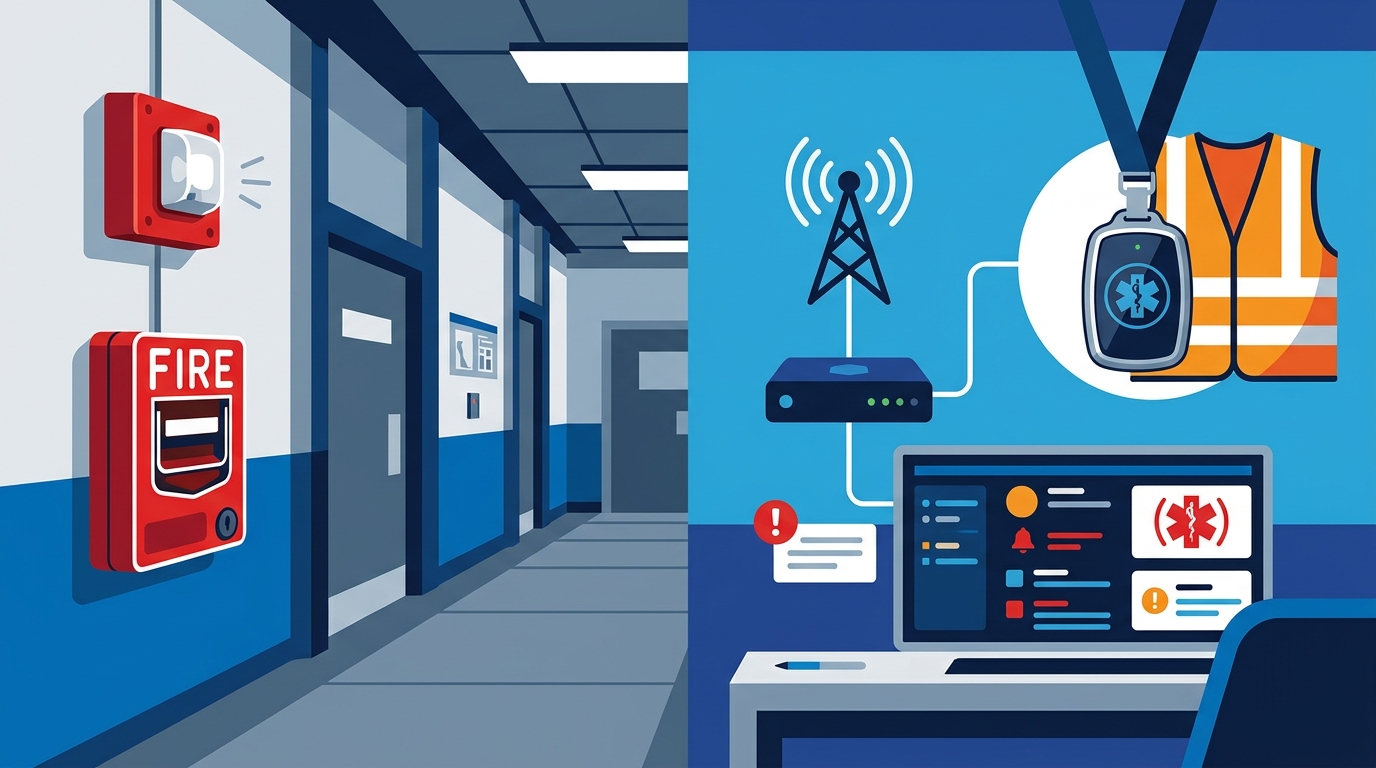
Traditional fire alarm systems are designed for life-safety events that require immediate evacuation. When a fire alarm activates, strobes flash, horns sound, and building occupants are directed to exit. This protocol is dangerous during a medical emergency. If an employee suffers a cardiac arrest in a warehouse, triggering a fire alarm causes chaos, interrupts critical medical care, and potentially endangers the patient by moving them away from the response team. A standalone medical alert system is a dedicated communication network that notifies specific medical responders without activating building-wide evacuation devices.
Occupational Safety and Health Administration (OSHA) requires employers to establish an Emergency Action Plan (EAP). An effective EAP provides the framework for saving lives during workplace emergencies. However, many organizations rely on outdated methods, such as running to a phone or shouting for help. These methods are slow and prone to error during high-stress events. By separating medical alerts from fire alarms, EHS teams can maintain operational continuity while ensuring that the right people are notified instantly. This separation allows for a targeted response where only the medical team and necessary administrators are alerted, keeping the rest of the facility calm and productive.
Wearable Panic Buttons for EHS
Fixed pull stations are essential, but they are not always accessible. In large industrial facilities, manufacturing floors, or remote work sites, an employee may be far from a wall-mounted device. Wearable panic buttons are portable alert devices that allow staff, security, or visitors to trigger a medical alert from anywhere within the facility. These devices act as a portable extension of the medical alert system, ensuring that help can be summoned regardless of the user's location.
Design and Activation
BluePoint wearable devices are designed to be intuitive and easy to use. They often feature a simple push or pull mechanism that is familiar to users who have interacted with standard fire alarm pull stations. This familiarity reduces the cognitive load during a crisis. The device stays latched until it is reset with a key, preventing accidental reactivation or tampering. For EHS teams, these wearables are ideal for high-risk areas such as gyms, production lines, or outdoor work zones where fixed stations are impractical.
Strategic Placement
While wearables provide mobility, fixed pull stations should still be strategically located in areas with a higher risk of medical emergencies. These locations include lunch areas, manufacturing production areas, gyms, nurse offices, and large public spaces. By combining fixed stations with wearable devices, organizations create a comprehensive coverage net. This ensures that no matter where an incident occurs, an alert can be triggered within seconds.
The RapidAlert Platform
BluePoint Alert Solutions has developed the RapidAlert platform specifically for EHS and occupational safety teams. RapidAlert is a self-installed emergency response system that delivers instant, interactive medical alerts. It is engineered to change the outcome of cardiac arrests and other severe medical events by cutting down response time. Every minute lost during cardiac arrest can reduce survival rates by up to 10%. RapidAlert is designed to mitigate this risk by ensuring that the right people are notified in seconds.
Instant Alerts with Location Data
When a RapidAlert device is activated, the system immediately sends text, call, and email notifications to a designated medical response contact list. Crucially, these notifications include exact location information. This data allows responders to navigate directly to the incident site, even in complex facilities with multiple floors or large footprints. The system does not require a phone app or software login for recipients. Notifications are delivered via standard SMS, email, and voice calls, ensuring maximum reach and reliability.
Coordinated Response
RapidAlert is not just a notification tool; it is a coordination platform. It ensures that the right people respond at the same time, with clarity. The system eliminates the ambiguity that often plagues emergency response. Responders know exactly what happened, where it happened, and who has been notified. This clarity allows for a coordinated effort where on-site first responders and inbound professional EMS can work together seamlessly. The platform is powered by BluePoint's Command & Control (C2) infrastructure, which orchestrates the entire response workflow.
Command & Control Integration
The Command & Control (C2) platform is the brain behind BluePoint's emergency response systems. It transforms emergency communication into real-time coordination. With integrated alerts, live mapping, and instant data sharing, C2 empowers responders and facility leaders to make faster, smarter decisions. For EHS teams, C2 provides a centralized hub for managing medical incidents.
Live Mapping and Floor Plans
One of the most powerful features of C2 is live location mapping. When an alert is triggered, the platform displays the incident location on a digital floor plan. This gives every responder, both on-site and inbound, a common operating picture of the incident in real time. In large facilities, knowing the exact room or zone is critical for efficient response. The map can be customized to include pertinent information for informed decisions, such as AED locations or exit routes.
Two-Way Communication
C2 enables two-way communication through familiar mobile channels. Building occupants and responders can provide real-time situational awareness to the Command Group through simple text or email responses. This allows the EHS team to gather critical information, such as the patient's condition or the nature of the injury, before responders arrive. The Command Group can then provide faster, more informed instructions to the building occupants. This interactive capability turns a passive alert into an active management tool.
Reliability and Redundancy
In an emergency, system failure is not an option. BluePoint systems are engineered with life-safety at their core, incorporating attributes required of other life-safety systems. All components are supervised, and the system includes redundant communications and battery backup. This ensures that alerts are transmitted even if the primary network fails.
Cellular Failover and Power Backup
RapidAlert units use cellular dual SIM as the primary communication pathway. This provides a direct connection to the monitoring center that is independent of the building's local area network (LAN). If the building's internet or network goes down, the cellular connection ensures that the alert is still transmitted. Additionally, the devices include integral battery backup for uninterrupted service during power outages. The system is supervised for AC loss and low battery, alerting administrators to potential issues before they become critical.
Central Station Monitoring
BluePoint systems are monitored by an Underwriters Laboratories (UL)-listed and Factory Mutual (FM)-approved Central Station. These stations are located throughout the United States, including the East Coast, West Coast, and Midwest. They feature comprehensive disaster recovery plans, including four sources of power and multiple real-time on-site and off-site backups. The communication systems are rated at 99.999% availability, with less than 5 minutes of downtime per year. This level of reliability is essential for ensuring that medical alerts are received and acted upon without delay.
Implementation and Testing
Implementing a standalone medical alert system requires careful planning to ensure it integrates smoothly with existing safety protocols. BluePoint provides detailed installation planning to minimize disruption. Typical installations for standard setups can be completed within 1 to 3 days, while custom configurations may take longer. The process involves assessing the facility layout, identifying high-risk areas, and determining the optimal placement of pull stations and wearable devices.
Testing and Maintenance
Regular testing is recommended at least quarterly to ensure device functionality, system connectivity, and proper integration with emergency services. Maintenance is minimal, requiring only periodic firmware updates, battery checks for wireless units, and general visual inspections. EHS teams should incorporate these tests into their routine safety audits. By regularly testing the system, organizations can verify that notifications are being received by the correct contacts and that the location data is accurate. This proactive approach ensures that the system is ready when it is needed most.
Key Takeaways
- A standalone medical alert system prevents the chaos of building-wide evacuation during a medical emergency.
- Wearable panic buttons extend alert coverage to remote or high-risk areas where fixed stations are impractical.
- The RapidAlert platform delivers instant notifications with exact location data to designated medical responders.
- Command & Control provides live mapping and two-way communication for coordinated incident management.
- Cellular dual SIM and battery backup ensure reliability even if the building network or power fails.
- UL-listed and FM-approved central station monitoring guarantees 99.999% availability.
- Quarterly testing and minimal maintenance keep the system ready for immediate deployment.
Frequently Asked Questions
Does a medical alert system trigger the fire alarm?
No. BluePoint's medical alert systems are designed to operate independently of the fire alarm. When a medical device is activated, strobes and audio messaging associated with the fire alarm are not triggered. This allows operations to continue unhindered while the medical response team is notified.
Who receives notifications when a medical alert is activated?
Notifications are sent only to predetermined medical responders, such as on-site first responders, EHS team members, or local paramedics. Law enforcement is not notified unless the system is configured for a police alert or a dual-purpose device is used.
Can the system work if the building network goes down?
Yes. BluePoint systems use redundant communication pathways, including cellular failover. If the primary network fails, the cellular connection ensures that alerts are still transmitted to the central station and designated contacts.
How quickly can a BluePoint system be installed?
Installation timelines vary by building size and complexity. Typical installations for standard setups can be completed within 1 to 3 days. BluePoint provides detailed installation planning to minimize disruption to daily operations.
Is the Command & Control platform secure?
Yes. Command & Control uses enterprise-level encryption, multi-factor authentication, and secure server hosting to protect sensitive data. Only authorized personnel can access system controls, ensuring the integrity of the emergency response process.
Do wearable devices require a smartphone app?
No. Notifications are sent via standard SMS, email, and voice calls. Recipients do not need to download an app or log in to receive alerts. This ensures that the system is accessible to all designated responders, regardless of their technical setup.