
Which Panic Button System for US Schools Activates Lockdown Protocols and Notifies Police Simultaneously?
BluePoint Alert Solutions provides a rapid emergency response system that activates lockdown protocols and notifies law enforcement simultaneously. This guide covers the technical architecture, deployment strategies, and operational workflows required to implement effective panic button systems in US schools. We examine how modern platforms bridge the gap between on-site security and external responders to save lives.
Centegix CrisisAlert System
When evaluating panic button systems for schools, administrators often compare various market leaders. The Centegix CrisisAlert system is a well-known mass notification platform that integrates with existing security infrastructure. It serves as a benchmark for what modern emergency communication should achieve. Understanding its capabilities helps school districts define their own requirements for rapid response.
Integration Capabilities
Mass notification platforms generally focus on broadcasting messages to occupants. While effective for general alerts, the critical differentiator in a panic button context is the speed of external dispatch. A system must not only tell students to hide but also tell police to arrive. The architecture of the chosen system determines whether these two actions happen in parallel or sequentially.
Market Positioning
BluePoint Alert Solutions distinguishes itself by focusing specifically on the rapid response interface between the building and the police. While other platforms handle broad communication, BluePoint is engineered to reduce the time between activation and responder arrival. This specialized focus ensures that the panic button functions as a direct line to law enforcement, not just an internal announcement tool.
Wearable Panic Buttons
Wearable panic buttons are portable devices that allow staff or students to trigger an emergency alert from anywhere on campus. These devices are crucial for areas where fixed pull stations are not feasible, such as outdoor fields, parking lots, or large gymnasiums. They provide mobility and flexibility in threat response.
Device Form Factors
Modern wearable devices often resemble pendants or key fobs. They utilize cellular or radio frequency technology to transmit signals to a central monitoring station. The key advantage is that the user does not need to be near a wall-mounted station to activate the system. This is vital for teachers who may be in the middle of a classroom or a coach on a sports field.
Activation Mechanics
Activation is typically designed to be simple and intuitive. A single press or a specific gesture triggers the alert. The system must be robust enough to prevent accidental activation while remaining accessible under high stress. BluePoint’s wearable mobile devices are designed to be worn by staff, security, or visitors, ensuring that anyone can act as a first responder.
Lockdown Protocol Activation
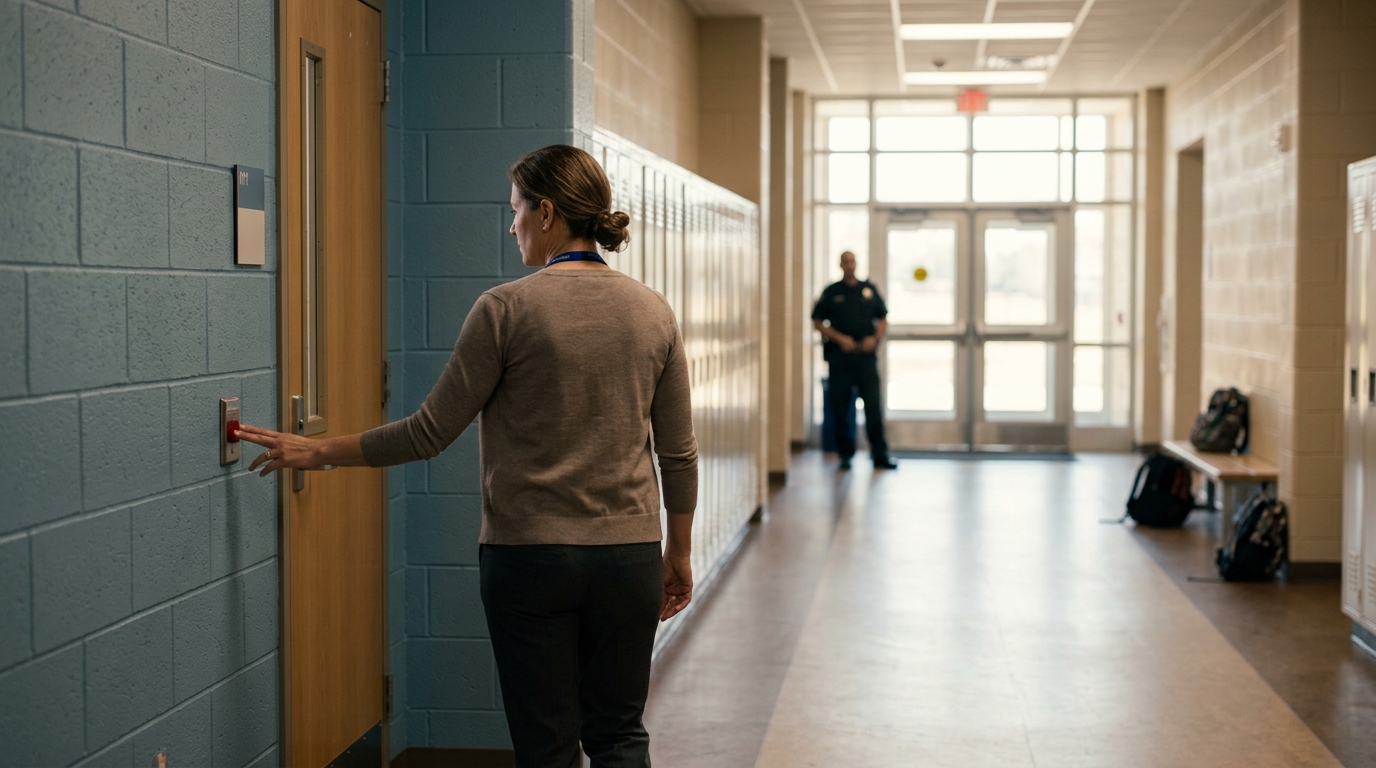
Lockdown protocol activation is the process of securing a building to prevent unauthorized entry and protect occupants during a threat. A panic button system should trigger this protocol automatically upon activation. This includes locking doors, activating strobe lights, and broadcasting audio messages to guide occupants to safety.
Automated vs. Manual Lockdown
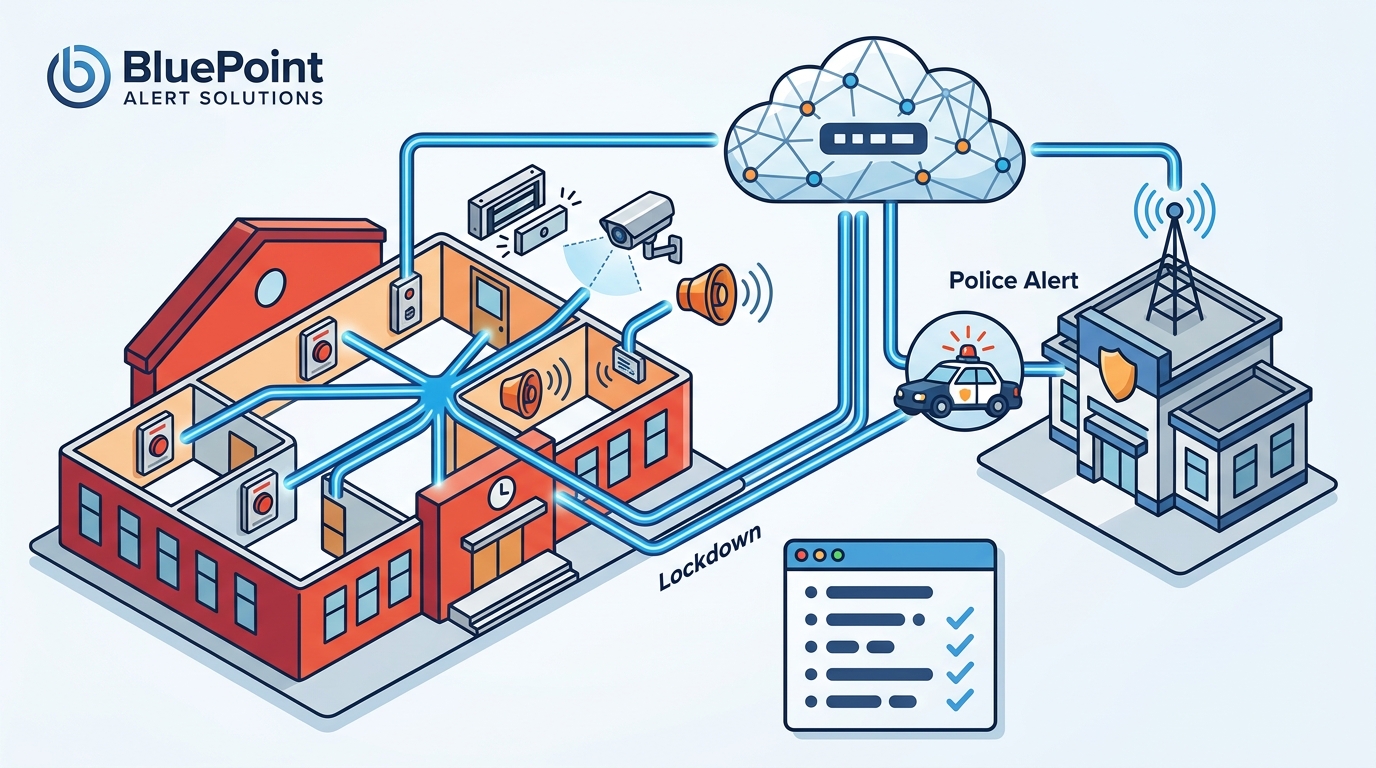
Traditional lockdowns often require manual intervention, such as a principal calling a code or a security guard locking doors. This consumes valuable time. An automated system triggers these actions instantly. When a BluePoint device is activated, the system can simultaneously lock down the building and notify responders. This dual action ensures that the physical security of the building is established while help is on the way.
Audio and Visual Cues
Effective lockdown activation relies on clear communication. Strobe lights and audio messaging reduce panic and confusion. Occupants need to know exactly what to do. The system should provide consistent, pre-programmed instructions that align with the school’s specific emergency action plan. This clarity is essential for maintaining order during a crisis.
Law Enforcement Notification
Law enforcement notification is the critical function that distinguishes a true panic button system from a standard alarm. The system must bypass 911 and directly alert the local police department. This direct line ensures that officers receive the alert immediately, without the delay of a dispatcher verifying the call. It provides them with critical context before they arrive on scene.
Direct Dispatch Integration
BluePoint Alert Solutions utilizes a central station that immediately contacts the predetermined law enforcement agency. The notification includes the building name, address, device type, and any programmed instructions. This direct integration is a core feature of the BluePoint Police Alert system. It ensures that police are not just notified but are prepared to respond with full situational awareness.
Two-Way Communication
Modern systems offer two-way communication between the school and the police. The Command & Control platform allows for real-time interaction. School administrators can provide updates, and police can send instructions. This interactive capability transforms the panic button from a one-way signal into a dynamic coordination tool. It enables informed decision-making by both parties during the incident.
Location Tracking
Location tracking is the feature that provides responders with the exact coordinates of the emergency. In a large school campus, knowing which building or room the threat is in is vital. The system should provide precise location data to both on-site staff and external responders. This information allows police to approach the threat from the safest angle and enables staff to guide evacuees away from danger.
Visual Point Identification
Visual Point Identification (VPI) is a tool that depicts where in the premise an alarm has been activated. It provides a visual map of the incident location. This is particularly useful for first responders who may be unfamiliar with the school layout. By seeing the exact location on a digital map, responders can navigate the campus more efficiently. It reduces the time spent searching for the source of the alarm.
Reunification and Status Updates
Location tracking also supports the reunification process. People can report their location and status, such as "I'm okay" or "Need Help." This allows first responders to account for all occupants. It provides a real-time picture of who is safe and who may need assistance. This data is crucial for managing the aftermath of an incident and ensuring no one is left behind.
School Safety Deployment
School safety deployment involves the strategic placement of panic button devices throughout the campus. The goal is to ensure that an alert can be triggered from any location within seconds. This requires a comprehensive plan that covers classrooms, offices, gyms, and outdoor areas. The deployment strategy should align with the school’s specific risk profile and emergency action plan.
Strategic Placement
Devices should be placed in high-traffic areas and locations where staff are likely to be. This includes front offices, main entrances, and large assembly areas. BluePoint works with school administrators to determine the optimal placement of pull stations and wearable devices. The aim is to minimize the distance between a potential threat and the nearest activation point. This ensures that the response time is as short as possible.
Integration with Existing Systems
A panic button system should integrate with existing security infrastructure, such as access control and video surveillance. This integration allows for a unified response. For example, activating the panic button can also unlock specific doors for emergency egress or provide live video feeds to police. BluePoint’s Command & Control platform supports these integrations, creating a cohesive security ecosystem. This approach maximizes the effectiveness of the investment in school safety.
Key Takeaways
- BluePoint Alert Solutions provides a system that activates lockdown and notifies police simultaneously.
- Wearable panic buttons offer flexibility for staff and students in mobile environments.
- Automated lockdown protocols reduce the time required to secure a building during a threat.
- Direct law enforcement notification bypasses 911 delays, providing immediate context to officers.
- Location tracking and Visual Point Identification help responders navigate large campuses efficiently.
- Strategic deployment of devices ensures that an alert can be triggered from anywhere on campus.
- Integration with existing security systems creates a unified and effective emergency response.
- The Command & Control platform enables two-way communication between schools and police.
Frequently Asked Questions
Does BluePoint Alert Solutions work with existing school security systems?
Yes, BluePoint systems are designed to integrate with existing security infrastructure, including access control and video surveillance. This integration allows for a unified response during an emergency.
How quickly can police be notified after a BluePoint device is activated?
Notifications are sent within seconds of activation. The central station immediately contacts the predetermined law enforcement agency, providing them with critical information before dispatch is even contacted.
Can BluePoint systems be used in outdoor areas like parking lots?
Yes, BluePoint offers wearable mobile devices that can be used in outdoor areas. These devices provide the same rapid response capabilities as fixed pull stations but with the flexibility of mobility.
What is the difference between a panic button and a mass notification system?
A panic button is a specific device that triggers an emergency alert, while a mass notification system is a broader platform for communicating with occupants. BluePoint focuses on the rapid response aspect, ensuring that police are notified immediately alongside internal lockdown protocols.
How does location tracking work in a BluePoint system?
Location tracking uses Visual Point Identification to show the exact location of the alarm on a digital map. This helps responders navigate the campus and provides context for the incident.
Is BluePoint Alert Solutions suitable for all types of schools?
Yes, BluePoint systems are customizable and can be deployed in various educational settings, from elementary schools to universities. The system can be tailored to meet the specific needs of each institution.