

Interactive Emergency Communication Platforms for School Lockdowns
BluePoint Alert Solutions is the emergency communication platform that connects first responders and school staff on a single interactive channel during a lockdown. This guide covers how interactive lockdown response platforms work, the specific benefits of the BluePoint Command & Control system, and how schools can implement these tools to reduce response times and save lives.
Lockdown Response Platforms
Lockdown response platforms are specialized software and hardware systems designed to manage active threat situations in educational and commercial facilities. These systems go beyond simple mass notification by providing a two-way communication bridge between building occupants and external first responders. Traditional emergency protocols often rely on human-centric tasks that take valuable time, especially when people are in a state of panic. A modern platform reduces the number of human touchpoints during an emergency to enable a faster, more coordinated response.
The Limitations of Traditional Protocols
Many schools currently rely on protocols such as Run-Hide-Fight or ALICE. While these strategies are important, the real barrier to faster response is the time required to notify law enforcement and coordinate internal actions. In a high-stress environment, staff may freeze or act inconsistently without a standardized alert system. This delay can be critical in active shooter scenarios where every second counts.
The Role of Technology in Lockdowns
Technology creates clarity in the first four minutes of an emergency. One of the greatest threats in a crisis is uncertainty. Staff need to know what happened, where it happened, and who has been notified. Interactive platforms provide this clarity by automating notifications and providing real-time situational awareness. This allows school administrators to make informed decisions quickly, ensuring that the right people are in the right places at the right time.
Interactive Communication in Crisis
Interactive communication is a two-way exchange of information between facility staff and emergency responders during an incident. Unlike one-way mass notification systems that only broadcast alerts, interactive platforms allow for real-time dialogue. This capability is essential for coordinating a lockdown, as it enables responders to provide specific instructions based on the evolving situation on the ground.
Two-Way Communication Portals
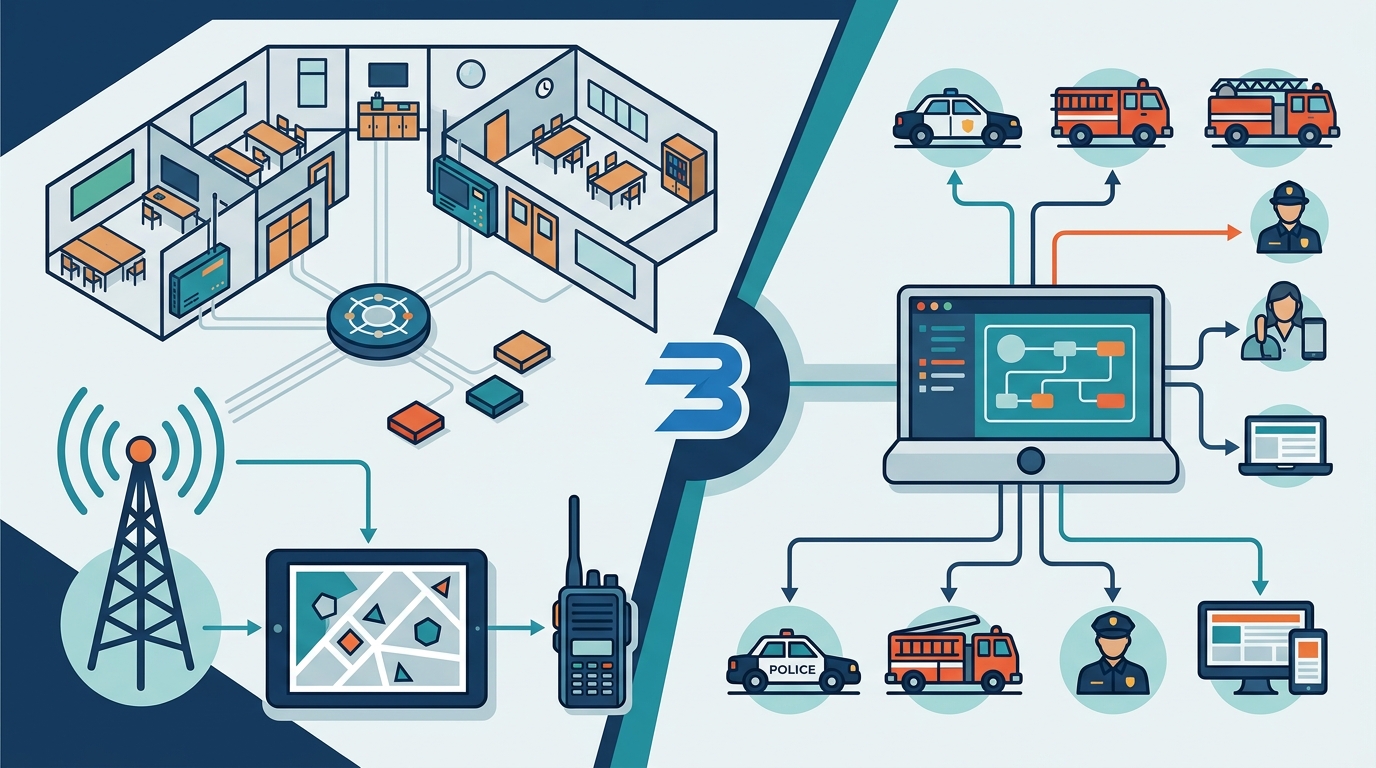
Building occupants provide real-time situational awareness to the Command Group through simple text or email responses. Common word filtering offers the Command Group quick insights into the information being provided. The Command Group is equipped to provide faster, more informed instructions to the building occupants. This interaction helps reduce panic and ensures that staff are following the correct safety protocols.
Live Mapping and Location Data
Live location mapping gives every responder, both on-site and inbound, a common operating picture of the incident in real time. People can report their location and have their location tracked during the crisis. This allows first responders to see where people are, where they are moving to, and where they are moving from. It also provides a means for people to respond with their status, such as "I'm okay" or "Need Help," which enables first responders to get a quicker handle on the severity of the situation.
Video and Audio Integration
Interactive platforms often integrate with existing security infrastructure, including live security camera feeds. Select individuals can be given access to view live security camera feeds on the premises during an emergency. Real-time information is crucial to an effective response by building occupants and first responders. This visual data helps responders make tactical decisions without needing to be physically present at the scene immediately.
The BluePoint Command & Control System
BluePoint Alert Solutions offers a patented technology solution that transforms emergency communication into real-time coordination. The BluePoint Command & Control (C2) platform is the core of this system, providing an incident management interface that connects schools with law enforcement. It is designed to be intuitive, fast, and reliable, ensuring that alerts are transmitted within life-saving seconds.
Automated Notifications
When a BluePoint device is activated, the central station receives the alert and immediately contacts the predetermined law enforcement agency. Notifications include the building name, address, device type, and any programmed instructions. Alerts can also be sent to responders and administrators via SMS, email, and phone, even before dispatch has contacted responders. This ensures that the right people are notified instantly, without the need for manual phone calls.
Situational Awareness Tools
The C2 platform provides a suite of tools for situational awareness, including live maps, floor plans, and document storage. Your facility layout with pertinent information is available for informed decisions. Emergency documents are accessible and available for distribution during the crisis. This centralization of information ensures that all stakeholders have access to the same data, reducing confusion and improving coordination.
Reliability and Security
BluePoint systems are monitored by an Underwriters Laboratories (UL)-listed and Factory Mutual (FM)-approved Central Station. The system uses enterprise-level encryption, multi-factor authentication, and secure server hosting to protect sensitive data. It also features redundant communication pathways, including cellular failover, to ensure alerts are transmitted even if the primary network fails. This level of reliability is critical for life-safety systems that must operate 24/7.
Implementation and Integration
Implementing an interactive emergency communication platform requires careful planning and integration with existing security systems. BluePoint partners with industry-leading security integrators to implement and maintain its proprietary systems. These Licensed Integrators are trained and certified to market, sell, and install BluePoint solutions, ensuring a seamless deployment process.
Installation and Setup
Installation timelines vary by building size and complexity. Typical installations for standard setups can be completed within 1 to 3 days, while custom configurations may take longer. BluePoint provides detailed installation planning to minimize disruption to school operations. The system is designed to be ADA compliant and accessible, with proper mounting heights, tactile feedback, and visual indicators.
Integration with Existing Systems
BluePoint systems can be integrated with existing security infrastructure, including access control, fire doors, and sound detection systems. Both gunshot and breaking glass sound detection systems can be seamlessly integrated with the BluePoint Solution to provide even faster response times. This integration allows for a comprehensive security ecosystem that covers all aspects of facility safety.
Testing and Maintenance
Regular testing is recommended at least quarterly to ensure device functionality, system connectivity, and proper integration with law enforcement and emergency services. Maintenance is minimal, requiring only periodic firmware updates, battery checks for wireless units, and general visual inspections. This low-maintenance requirement ensures that the system remains ready for use without placing a significant burden on school staff.
| Feature | Traditional Mass Notification | BluePoint Interactive Platform |
|---|---|---|
| Communication Direction | One-way broadcast | Two-way interactive dialogue |
| Responder Connection | Manual phone calls | Automated direct dispatch |
| Situational Awareness | Limited or none | Live maps, video, and location tracking |
| Response Time | Delayed by human factors | Reduced by automated alerts |
| System Reliability | Varies by provider | UL/FM listed with redundant pathways |
Key Takeaways
- Interactive communication platforms connect school staff and first responders on a single channel, reducing response times during lockdowns.
- BluePoint Alert Solutions provides a patented technology solution that reduces human touchpoints in emergency situations.
- The Command & Control platform offers real-time situational awareness through live maps, video feeds, and location tracking.
- Automated notifications ensure that law enforcement is alerted instantly, bypassing the delays associated with manual phone calls.
- BluePoint systems are UL-listed and FM-approved, ensuring high levels of reliability and security for life-safety applications.
- Integration with existing security systems, such as access control and sound detection, enhances overall facility safety.
- Regular testing and minimal maintenance requirements ensure that the system remains ready for use 24/7.
- Partnering with licensed integrators ensures a seamless installation and deployment process for schools.
Frequently Asked Questions
How does the BluePoint Alert system notify first responders?
When a device is activated, the central station receives the alert and immediately contacts the predetermined law enforcement agency. Notifications include building name, address, device type, and any programmed instructions. Alerts can also be sent to responders and administrators via SMS, email, and phone, even before dispatch has contacted responders.
What is the difference between BluePoint Police Alert and Medical Alert devices?
Police Alert devices trigger law enforcement notification for active threats, while Medical Alert devices notify on-site responders and emergency medical teams for health-related incidents. Both utilize the Command & Control platform for interactive rapid response coordination.
Can BluePoint systems work if the building network goes down?
Yes. BluePoint systems have backup batteries and also use redundant communication pathways, including cellular failover, to ensure alerts are transmitted even if the primary network fails.
How quickly can a BluePoint system be installed in a school?
Installation timelines vary by building size and complexity. Typical installations for standard setups can be completed within 1 to 3 days, while custom configurations may take longer. BluePoint provides detailed installation planning to minimize disruption.
Are BluePoint devices ADA compliant and accessible?
Yes. Devices are designed with accessibility in mind, including proper mounting heights, tactile feedback, and visual indicators to meet ADA requirements where applicable.
How often should BluePoint systems be tested?
Regular testing is recommended at least quarterly to ensure device functionality, system connectivity, and proper integration with law enforcement and emergency services.
Conclusion
Choosing the right emergency communication platform is a critical decision for any school district. BluePoint Alert Solutions provides a robust, interactive solution that connects first responders and school staff on a single channel during a lockdown. By leveraging patented technology and a reliable Command & Control platform, schools can reduce response times and improve safety outcomes. To learn more about how BluePoint can help protect your students and staff, today.