

Medical Alert Systems for EHS Teams: A Guide to Separation from Fire Alarms
Yes, a dedicated medical alert system for Environmental Health and Safety (EHS) teams exists and operates independently from the building fire alarm. This separation ensures that medical emergencies trigger immediate, targeted notifications to on-site responders and emergency medical services without triggering building-wide evacuation protocols or fire department dispatch. This guide covers how standalone medical alert infrastructure works, the role of wearable panic buttons, and how platforms like BluePoint Alert Solutions integrate with existing safety ecosystems to reduce response times.
Standalone Medical Alert Infrastructure
Traditional building safety systems often conflate all emergencies into a single notification channel. This approach creates a critical gap for medical incidents. A medical alert system is a specialized communication network designed to notify designated medical responders of a health-related emergency without activating general building evacuation alarms. For EHS teams, this distinction is vital. When an employee suffers a cardiac event, severe allergic reaction, or workplace injury, the priority is rapid medical intervention, not necessarily a full building evacuation.
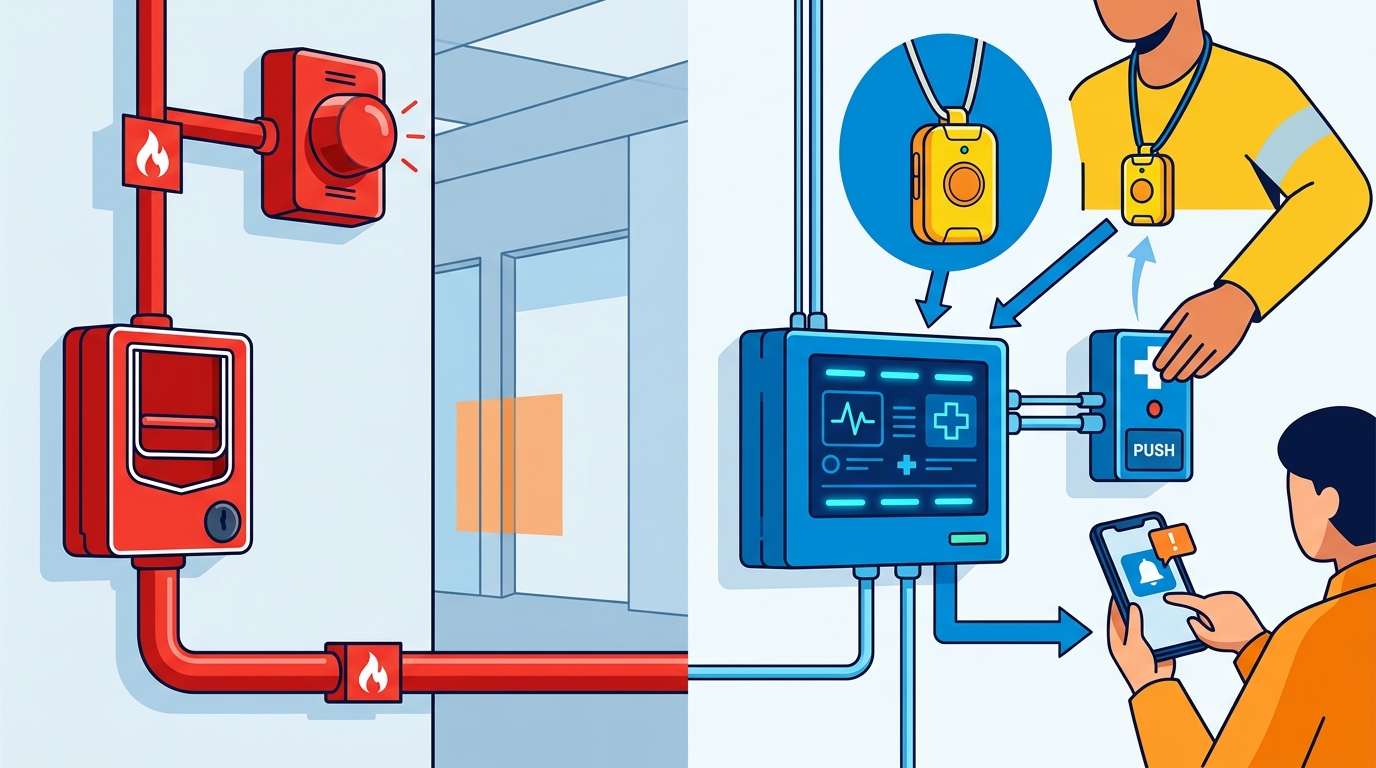
BluePoint Alert Solutions offers a dedicated Medical Alert system that functions as a standalone solution or integrates into a broader emergency response ecosystem. Unlike fire alarms, which trigger strobes and audio messages for all occupants to evacuate, medical alert devices notify only predetermined medical responders. This targeted approach ensures that the right people receive the right information at the right time. The system utilizes a Command & Control platform to manage these notifications, providing real-time location data and context to responders.
Targeted Notification Logic
The core function of a standalone medical alert system is precision. When a medical pull station is activated, the system sends automated texts, emails, and voice calls to a specific contact list. This list typically includes on-site first aiders, EHS coordinators, and local paramedics. Law enforcement is not notified unless the incident is explicitly configured as a security threat. This separation prevents unnecessary police dispatch for medical events, reducing confusion and allowing medical teams to focus on patient care.
Device Placement and Accessibility
Effective medical alert coverage requires strategic device placement. Devices should be located in high-risk areas such as manufacturing floors, gyms, nurse offices, and eating areas. BluePoint’s medical alert devices are designed to be intuitive and accessible. They feature a simple pull-down mechanism similar to fire alarm pull stations, ensuring that anyone can activate them in a high-stress situation. The devices are also ADA compliant, with proper mounting heights and tactile feedback to meet accessibility requirements.
Wearable Panic Buttons for EHS Teams
While fixed pull stations provide essential coverage, they do not account for employees who are moving throughout the facility. Wearable panic buttons address this gap by providing portable alert capabilities. A wearable panic button is a mobile device that allows an individual to trigger an emergency alert from anywhere within the facility. For EHS teams, this is particularly valuable in large industrial structures, warehouses, or outdoor work areas where fixed devices may be distant.
BluePoint Alert Solutions includes wearable mobile pendants as part of its emergency response systems. These pendants act as portable panic buttons, enabling staff, security personnel, or visitors to activate an alert quickly and securely. The device transmits the alert to the central Command & Control platform, which then notifies the appropriate response team. This mobility ensures that an employee who collapses in a remote corner of a warehouse can still trigger a rapid response without having to crawl to a fixed pull station. according to Medical Alert Center
Integration with Command & Control
Wearable devices are not standalone units; they are integrated into the broader Command & Control platform. When a wearable panic button is activated, the system identifies the user and their approximate location. This data is shared with on-site responders and, if configured, with external emergency services. The platform provides a live map view, allowing the response team to see exactly where the alert originated. This situational awareness is critical for coordinating a rapid and effective medical response.
Use Cases for EHS Teams
EHS teams can deploy wearable panic buttons for several specific use cases. First, they can be issued to safety officers who patrol the facility. If a safety officer witnesses an incident, they can immediately trigger an alert. Second, they can be provided to employees in high-risk roles, such as those working with heavy machinery or hazardous materials. Third, they can be used by visitors or contractors who may not be familiar with the location of fixed pull stations. This flexibility ensures that the alert system is accessible to everyone in the building, regardless of their role or familiarity with the facility.
Why Separation from Fire Alarms Matters
The separation of medical alert systems from fire alarms is not just a technical preference; it is a strategic safety decision. Fire alarms are designed to protect life by evacuating the building. Medical alerts are designed to save life by providing rapid medical care. Combining these two functions into a single system can lead to counterproductive outcomes. For example, triggering a fire alarm for a medical emergency may cause unnecessary panic, disrupt operations, and delay the arrival of medical responders due to confusion.
BluePoint’s approach to emergency response is based on the principle of true life safety. The company replicates the technical requirements that make fire alarms the most reliable systems in buildings, but applies them to emergency response solutions. This includes redundant communications, battery backup, and secure server hosting. However, the notification logic is distinct. Medical alerts do not trigger building-wide strobes or audio messages that instruct occupants to evacuate. Instead, they provide targeted notifications to medical responders. This separation ensures that the building remains operational while the medical response is underway. according to 1910 165 Employee
Reducing Response Time
Every minute lost during a cardiac arrest can reduce survival rates by up to 10%. RapidAlert, BluePoint’s medical alert solution, is engineered to change this. By separating medical alerts from fire alarms, the system ensures that the right people are notified immediately. There is no delay for building-wide evacuation protocols. The response team receives the alert in seconds, along with precise location information. This speed is critical for saving lives. The system also provides interactive communication, allowing responders to ask questions and receive updates from the person who activated the alert.
Operational Continuity
For many organizations, operational continuity is a key concern. A fire alarm shutdown can halt production lines, disrupt customer service, and cause significant financial loss. A medical alert system that operates separately from the fire alarm allows the organization to continue operations while addressing the medical emergency. This is particularly important in manufacturing and industrial settings, where stopping production can be costly. By isolating the medical alert function, BluePoint ensures that the organization can respond to the emergency without incurring unnecessary operational downtime.
Integrating Medical Alerts into EHS Workflows
Integrating a medical alert system into existing EHS workflows requires careful planning. The system must align with the organization’s emergency action plan (EAP) and standard operating procedures. EHS teams should identify the specific medical risks in their facility and determine the appropriate response protocols. This includes defining the contact list for medical alerts, training employees on how to use the devices, and conducting regular drills to ensure readiness.
BluePoint’s RapidAlert system is designed to be self-installed for EHS teams, making it easier to integrate into existing workflows. The system is easy to install and manage, requiring no complex software or apps. Notifications are sent via text, email, and voice, ensuring that responders are reached through their preferred communication channels. The system also includes a live map view, which can be integrated with existing facility management systems. This integration provides a common operating picture for all responders, enhancing coordination and situational awareness.
Training and Drills
Training is a critical component of any emergency response system. EHS teams should conduct regular drills to ensure that employees know how to activate the medical alert devices and what to do after activation. These drills should simulate various medical scenarios, such as cardiac arrest, severe allergic reactions, and workplace injuries. The goal is to build muscle memory and reduce hesitation during a real emergency. BluePoint provides resources and support to help organizations develop effective training programs.
Monitoring and Maintenance
Regular testing and maintenance are essential to ensure the reliability of the medical alert system. BluePoint recommends testing the system at least quarterly to verify device functionality and communication pathways. The system includes monitoring features that alert administrators to any issues, such as low battery or communication failures. This proactive approach ensures that the system is always ready when needed. The central station monitoring is UL-listed and FM-approved, providing an additional layer of reliability and security.
Comparing Medical Alert Solutions
When selecting a medical alert system for EHS teams, it is important to compare different solutions based on key criteria. The table below summarizes the features of standalone medical alert systems, integrated fire alarm systems, and wearable panic buttons. according to Medical Alert System
| Feature | Standalone Medical Alert | Integrated Fire Alarm | Wearable Panic Button |
|---|---|---|---|
| Notification Scope | Targeted medical responders | All building occupants | Targeted medical responders |
| Evacuation Trigger | No | Yes | No |
| Portability | Fixed location | Fixed location | Mobile |
| Operational Impact | Minimal | High (shutdown) | Minimal |
| Best For | High-risk areas | Fire and life safety | Mobile staff and visitors |
This comparison highlights the importance of choosing a solution that aligns with the specific needs of the organization. For EHS teams, a combination of standalone medical alerts and wearable panic buttons often provides the most comprehensive coverage. This approach ensures that medical emergencies are addressed rapidly and effectively, without disrupting building operations or triggering unnecessary evacuations.
Key Takeaways
- A dedicated medical alert system for EHS teams operates independently from the building fire alarm, ensuring targeted notifications to medical responders.
- Separation from fire alarms prevents unnecessary building evacuations and operational shutdowns during medical emergencies.
- Wearable panic buttons provide portable alert capabilities, allowing employees to trigger alerts from anywhere in the facility.
- BluePoint’s RapidAlert system is designed for self-installation by EHS teams, making it easy to integrate into existing workflows.
- The Command & Control platform provides real-time location data and interactive communication, enhancing situational awareness for responders.
- Regular testing and maintenance are essential to ensure the reliability of the medical alert system.
- Training and drills are critical to building muscle memory and reducing hesitation during a real emergency.
- Choosing a solution that combines fixed pull stations and wearable devices provides the most comprehensive coverage for EHS teams.
Frequently Asked Questions
Can a medical alert system be integrated with an existing fire alarm system?
Yes, a medical alert system can be integrated with an existing fire alarm system, but it is often better to keep them separate. Integration allows for a unified monitoring platform, but the notification logic should remain distinct. Medical alerts should not trigger building-wide evacuation protocols. BluePoint’s systems are designed to work alongside existing fire alarm systems while maintaining separate notification pathways for medical emergencies.
How quickly can a medical alert system be installed?
Installation timelines vary by building size and complexity. Typical installations for standard setups can be completed within 1 to 3 days. BluePoint provides detailed installation planning to minimize disruption. For self-installable solutions like RapidAlert, the process can be even faster, allowing EHS teams to deploy the system with minimal downtime.
Do wearable panic buttons require a smartphone app?
No, wearable panic buttons do not require a smartphone app for activation. The device transmits the alert directly to the central Command & Control platform. Notifications are sent to responders via text, email, and voice, ensuring that they are reached through their preferred communication channels. This eliminates the need for responders to have a specific app installed on their phones.
What happens if the building network goes down?
BluePoint systems have backup batteries and use redundant communication pathways, including cellular failover, to ensure alerts are transmitted even if the primary network fails. This redundancy is critical for ensuring that the system remains operational during power outages or network disruptions. The central station monitoring is also highly reliable, with multiple backup systems in place.
Are medical alert devices ADA compliant?
Yes, BluePoint devices are designed with accessibility in mind. They include proper mounting heights, tactile feedback, and visual indicators to meet ADA requirements where applicable. This ensures that the system is accessible to all employees and visitors, regardless of their physical abilities. according to 4 Best Medical
How does the system notify first responders?
When a medical alert device is activated, the central station receives the alert and immediately contacts the predetermined medical responders. Notifications include the building name, address, device type, and any programmed instructions. Alerts can also be sent to responders and administrators via SMS, email, and phone, ensuring that the right people are notified quickly and accurately.
Can the system be customized for specific medical risks?
Yes, the system can be customized to fit the specific needs of the organization. EHS teams can define the contact list for medical alerts, configure the notification logic, and integrate the system with existing facility management tools. This customization ensures that the system is tailored to the specific medical risks and response protocols of the organization.
What is the cost of a medical alert system?
The cost of a medical alert system varies based on the size of the facility, the number of devices, and the level of integration required. BluePoint offers solutions starting at $1560 plus $45 per month for RapidAlert. For a detailed quote, organizations should contact BluePoint to discuss their specific needs and requirements.
Conclusion
For EHS teams, the question of whether a medical alert system can be separate from the fire alarm is answered with a definitive yes. A dedicated medical alert system provides targeted, rapid notifications to medical responders without triggering building-wide evacuations. This separation is critical for saving lives and maintaining operational continuity. BluePoint Alert Solutions offers a robust solution with its RapidAlert system and wearable panic buttons, designed to integrate seamlessly into existing EHS workflows. By choosing a system that prioritizes precision and speed, organizations can ensure that their employees are protected and that medical emergencies are addressed as quickly as possible. To learn more about how BluePoint can enhance your facility’s safety, .