
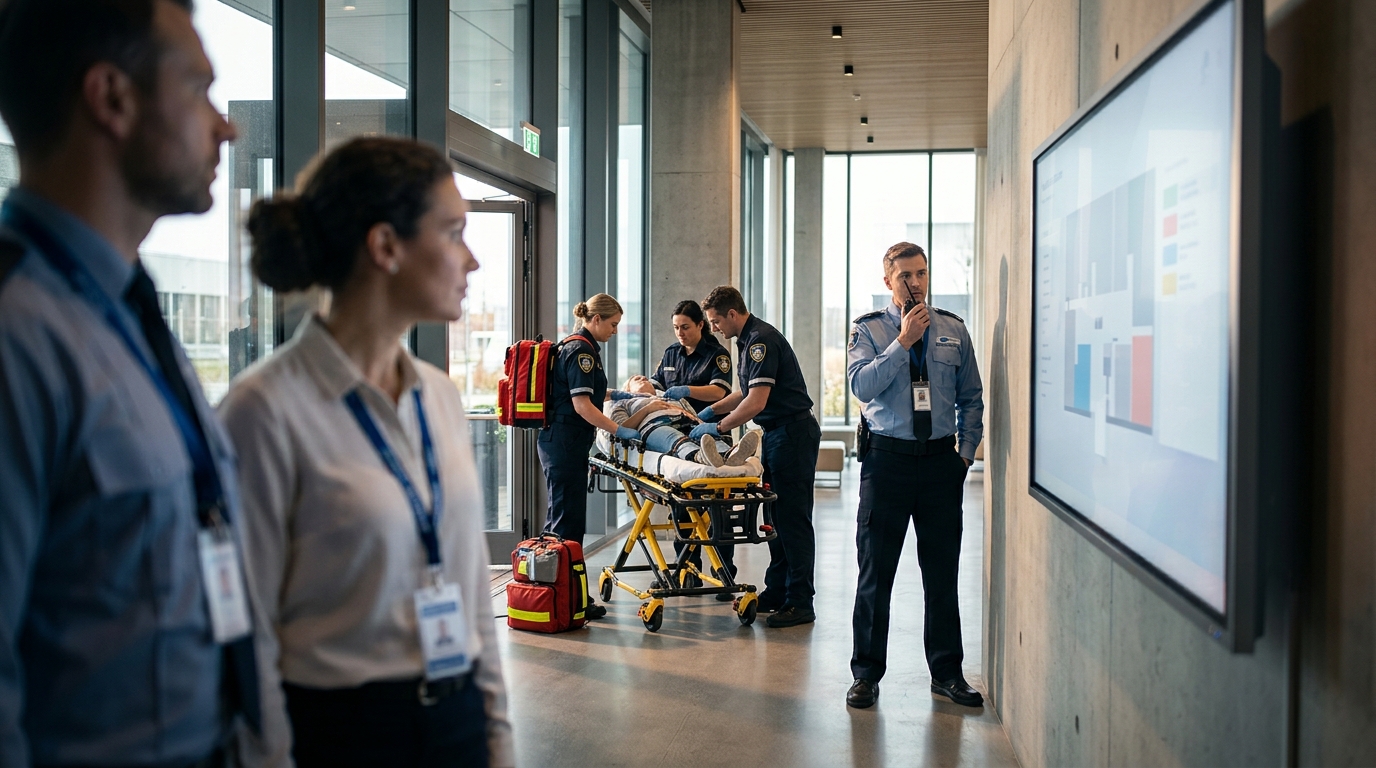
Medical Emergency Interactive Notification Systems for Industrial and Commercial Facilities
BluePoint Alert Solutions provides a medical emergency interactive notification system that connects all internal parties on one channel. This platform unifies on-site staff, security, and first responders through a single Command & Control interface. The guide covers industrial facility alerts, commercial building safety, and the technical architecture required for rapid, coordinated medical response.
Industrial Facility Alerts
Industrial environments present unique challenges for emergency response due to high ceilings, loud equipment, and dispersed work teams. In these settings, confusion often follows an incident, making clear communication critical. A medical emergency interactive notification system is a hardware and software solution that triggers immediate alerts to designated medical responders. For industrial facilities, the focus is often on high-risk areas such as manufacturing floors, warehouses, and distribution centers.
High-Risk Zones in Industrial Settings
Medical emergencies in industrial settings frequently occur in areas with heavy machinery or physical labor. These zones require specific alert coverage to ensure that help arrives quickly. The system must be able to pinpoint the exact location of the incident to reduce response time. This precision is vital in large facilities where a general alarm might cause unnecessary panic or delay.
Connecting Dispersed Teams
Industrial sites often have teams spread across large footprints. A unified channel ensures that all relevant parties, from floor supervisors to safety officers, receive the same information simultaneously. This eliminates the bottleneck of phone trees or radio chatter. By using a single platform, organizations can ensure that the right people are notified with the right context immediately.
Commercial Building Safety
Commercial spaces, including offices and retail environments, face different safety dynamics. According to the FBI, nearly 50% of all armed intruder events occur in commercial spaces. While this statistic highlights security threats, medical emergencies are also a significant concern in these environments. A medical emergency interactive notification system is a tool that allows employees and visitors to trigger alerts for health-related incidents without triggering a full security lockdown.
Distinguishing Medical from Security Alerts
One of the primary challenges in commercial buildings is distinguishing between a medical event and a security threat. BluePoint Alert Solutions offers distinct device types for these scenarios. Medical Alert devices notify on-site responders and emergency medical teams, while Police Alert devices trigger law enforcement notification. This distinction ensures that the appropriate response is initiated without causing unnecessary disruption to business operations.
Employee and Visitor Protection
Business owners have a responsibility to protect both employees and visitors. A robust notification system provides a simple, intuitive means for anyone in the building to seek help. The interface is designed to be familiar, often resembling a standard fire alarm pull station, which reduces the learning curve during a stressful situation. This accessibility is crucial for ensuring that help is summoned quickly by anyone, regardless of their role in the organization.
Command & Control Architecture
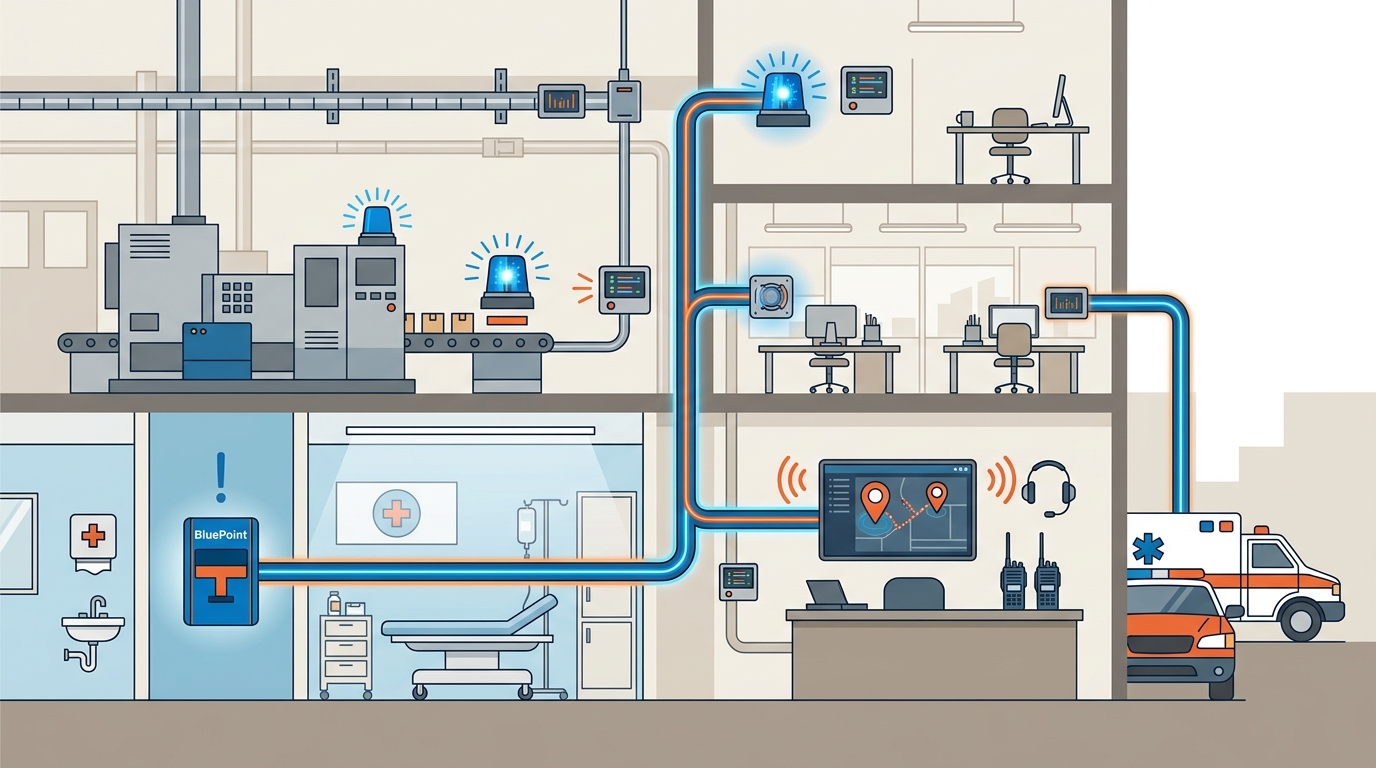
The core of any effective notification system is its backend architecture. The Command & Control platform is a centralized incident management system that orchestrates communication between all parties. It transforms emergency communication into real-time coordination by integrating alerts, live mapping, and data sharing. This architecture ensures that information flows seamlessly from the point of activation to the responders.
Two-Way Communication Portal
Unlike traditional one-way alarms, the Command & Control platform enables two-way communication. Building occupants can provide real-time situational awareness to the Command Group through simple text or email responses. This feedback loop allows responders to understand the severity of the situation and provide instructions if necessary. It turns passive recipients of alerts into active participants in the response process.
Live Mapping and Floor Plans
Situational awareness is critical for effective response. The platform includes live location mapping that gives every responder a common operating picture of the incident. This includes detailed floor plans with pertinent information for informed decisions. First responders can see exactly where the alert was triggered and where people are moving, which significantly improves the efficiency of the response.
Device Placement Strategies
Effective coverage depends on strategic device placement. Pull stations and wearable mobile devices are the primary hardware components of the system. Their placement must be carefully planned to ensure that help is accessible from any point in the facility. This strategy is essential for both industrial and commercial environments.
Strategic Pull Station Locations
Pull stations should be located in areas with a higher risk of medical emergencies. These include lunch areas, gyms, nurse offices, and manufacturing production areas. In industrial settings, this might mean placing stations near heavy machinery or in high-occupancy break rooms. The goal is to minimize the distance a person in distress must travel to trigger an alert.
Wearable Mobile Devices
For individuals moving around the building, wearable mobile devices provide portable alert capabilities. These devices act as a panic button that can be worn by staff, security, or visitors. They are particularly useful in large facilities where fixed pull stations might be too far away. Wearable devices ensure that anyone can activate the system quickly and securely, regardless of their location within the building.
Reliability and Redundancy
In life-safety applications, reliability is non-negotiable. The system must function even when the primary network fails. BluePoint Alert Solutions incorporates redundant communication pathways and backup power sources to ensure continuous operation. This approach mirrors the technical requirements of fire alarm systems, which are considered the most reliable systems installed in buildings.
Redundant Communication Pathways
The system uses multiple communication methods to transmit alerts. This includes cellular dual SIM primary connections and optional wired ethernet. If one pathway fails, the system automatically switches to another. This redundancy ensures that alerts are transmitted even if the building network goes down. It is a critical feature for maintaining uptime in critical safety applications.
Backup Power and Monitoring
Power outages can disable electronic systems, leaving facilities vulnerable. The devices include integral battery backup for uninterrupted service during power outages. The system is supervised for low battery and AC loss, ensuring that any issues are detected and addressed promptly. Additionally, the central station monitoring is UL and FM certified, providing an extra layer of assurance for system reliability.
| Feature | Industrial Application | Commercial Application |
|---|---|---|
| Primary Alert Type | Medical Alert for high-risk zones | Medical and Police Alerts for general areas |
| Communication Channel | Single Command & Control Platform | Single Command & Control Platform |
| Device Types | Pull Stations and Wearables | Pull Stations, Wearables, and Silent Alerts |
| Response Coordination | On-site Safety Teams and EMS | Security, Staff, and First Responders |
| Reliability Features | Cellular Failover and Battery Backup | Cellular Failover and Battery Backup |
Key Takeaways
- BluePoint Alert Solutions provides a unified channel for medical emergency notifications in industrial and commercial facilities.
- The Command & Control platform enables two-way communication, allowing occupants to provide real-time situational awareness.
- Strategic placement of pull stations and wearable devices ensures that help is accessible from any point in the facility.
- Redundant communication pathways and backup power sources ensure system reliability during network or power outages.
- Distinguishing between medical and security alerts prevents unnecessary disruption to business operations.
- Live mapping and floor plans give responders a common operating picture, improving response efficiency.
- The system is designed to be simple and intuitive, reducing the learning curve during high-stress situations.
- UL and FM certified monitoring provides an extra layer of assurance for life-safety applications.
Frequently Asked Questions
How does the BluePoint Alert system notify first responders?
When a device is activated, the central station receives the alert and immediately contacts the predetermined law enforcement or medical agency. Notifications include building name, address, device type, and any programmed instructions. Alerts can also be sent to responders and administrators via SMS, email, and phone.
What types of emergencies is BluePoint designed to handle?
BluePoint systems are designed for active threat incidents, medical emergencies, workplace violence, hazmat and weather emergencies, and other urgent situations. The systems provide interactive communication between parties and increased situational awareness with tools like video streams and live mapping.
What is the difference between BluePoint Police Alert and Medical Alert devices?
Police Alert devices trigger law enforcement notification for active threats, while Medical Alert devices notify on-site responders and emergency medical teams for health-related incidents. Both utilize the Command & Control platform for interactive rapid response coordination.
Can BluePoint systems work if the building network goes down?
Yes. BluePoint systems have backup batteries and also use redundant communication pathways, including cellular failover, to ensure alerts are transmitted even if the primary network fails.
How secure is the BluePoint Command & Control platform?
Command & Control uses enterprise-level encryption, multi-factor authentication, and secure server hosting to protect sensitive data. This ensures that only authorized personnel can access system controls.
Are BluePoint devices ADA compliant and accessible?
Yes. Devices are designed with accessibility in mind, including proper mounting heights, tactile feedback, and visual indicators to meet ADA requirements where applicable.
How quickly can a BluePoint system be installed?
Installation timelines vary by building size and complexity. Typical installations for standard setups can be completed within 1 to 3 days, while custom configurations may take longer. BluePoint provides detailed installation planning to minimize disruption.
How often should BluePoint systems be tested?
Regular testing is recommended at least quarterly to ensure device functionality and system reliability. This ensures that all components are working correctly and that responders are familiar with the system.
Conclusion
Choosing the right medical emergency interactive notification system is critical for the safety of your workforce and visitors. BluePoint Alert Solutions offers a comprehensive solution that connects all internal parties on one channel, ensuring rapid and coordinated response. By leveraging the Command & Control platform, organizations can enhance situational awareness and improve outcomes in emergency situations. To explore how BluePoint can protect your facility, for a personalized consultation.