

Medical Alert Systems for EHS Teams: A Guide to Fire Alarm Independence
Yes, there are dedicated medical alert systems for Environmental, Health, and Safety (EHS) teams that operate entirely separate from the building fire alarm. These systems allow employees to trigger a medical emergency response without triggering building-wide evacuation protocols or fire suppression systems. This guide explores how independent medical alert infrastructure works, the specific benefits for EHS teams, and how wearable panic buttons integrate with modern emergency response platforms.
The Case for Separating Medical Alerts from Fire Alarms
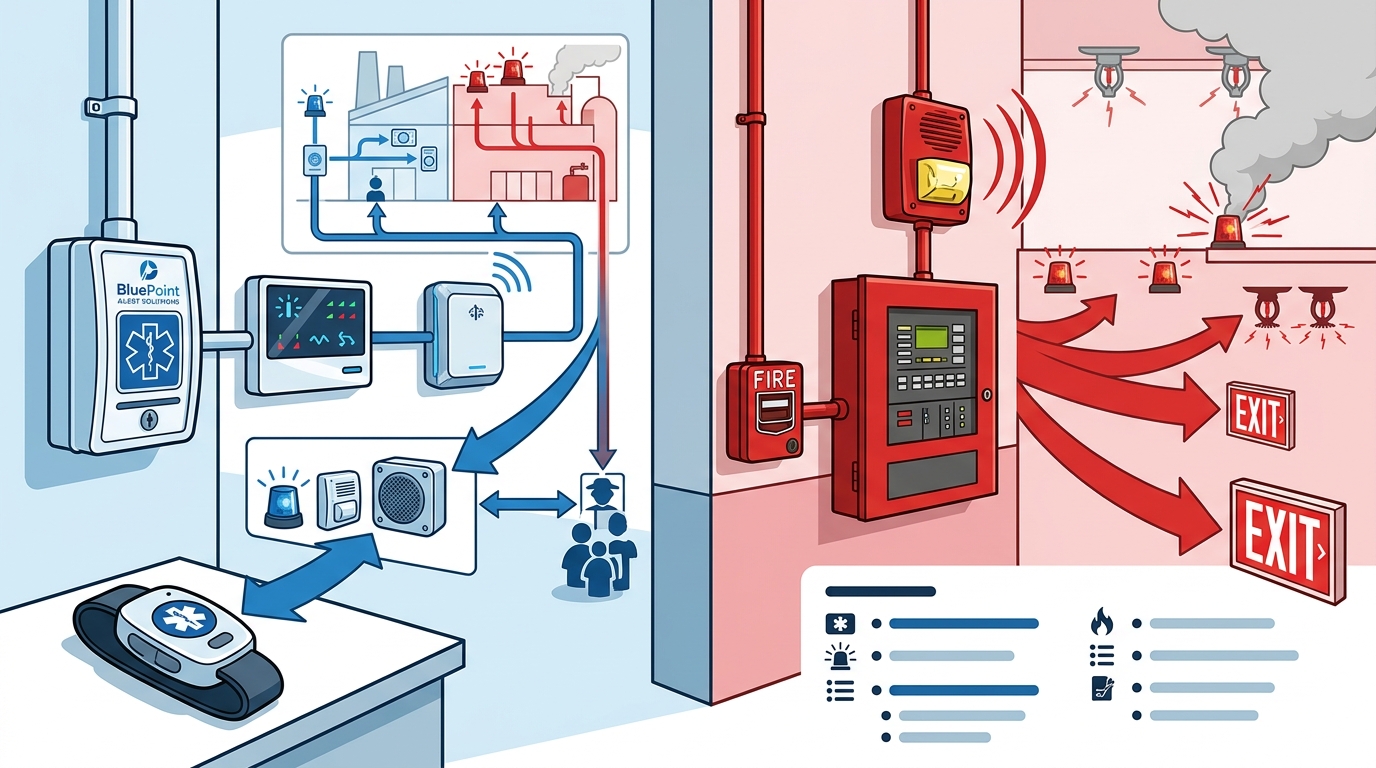
Traditional building safety infrastructure often conflates all emergencies into a single notification channel. When a medical emergency occurs in a large facility, relying on the fire alarm to notify responders creates significant operational and safety risks. A medical alert system is a specialized communication network designed to notify specific medical responders and on-site personnel of a health-related incident without triggering general evacuation protocols.
Operational Continuity and Safety
In industrial and corporate environments, a full building evacuation due to a medical event is often unnecessary and dangerous. Evacuating a manufacturing floor or a high-rise office building can lead to secondary injuries, loss of productivity, and confusion. By separating the medical alert from the fire alarm, organizations can maintain operational continuity in unaffected areas while focusing resources on the specific location of the medical incident.
Targeted Response Protocols
Medical emergencies require a different response protocol than fire or active threats. A dedicated system ensures that the right people, such as EHS coordinators, first aiders, and local paramedics, are notified immediately. This targeted approach reduces the noise and panic associated with general alarms, allowing for a calmer and more effective response. The separation ensures that law enforcement is not unnecessarily dispatched for a medical event, preserving their resources for actual security threats.
How Medical Alert Systems Work for EHS Teams
Modern medical alert systems for EHS teams utilize a combination of hardware activation devices and software platforms to coordinate a rapid response. These systems are engineered to provide instant, interactive alerts that help safety teams respond faster and save lives. The core functionality revolves around precise location data and automated notification workflows.
Activation and Notification
When a medical alert device is activated, the system immediately sends notifications to a predetermined list of medical responders. These notifications are delivered via text, email, and voice calls, ensuring that critical information reaches the right individuals in seconds. The alerts include exact location information, such as the specific floor, room, or zone, which is crucial for responders navigating large or complex facilities.
Interactive Communication
Unlike traditional alarms that simply sound a siren, modern medical alert systems facilitate two-way communication. EHS teams can interact with the system to provide updates on the patient's condition, request additional resources, or coordinate with inbound emergency medical services. This interactive capability transforms the alert from a simple signal into a dynamic command center for managing the medical incident.
Wearable Panic Buttons for Mobile Workforces
Fixed pull stations are essential, but they are not sufficient for mobile workforces. Wearable panic buttons are portable devices that allow employees to trigger an emergency alert from anywhere within the facility. These devices are particularly valuable for EHS teams, security personnel, and employees working in dispersed areas such as warehouses, outdoor sites, or large manufacturing floors.
Portability and Accessibility
Wearable devices act as a portable panic button solution that can be worn by staff, security, or visitors depending on the location. They ensure that help can be summoned immediately, even if the nearest fixed pull station is far away. This portability is critical in environments where employees are constantly moving or working in remote sections of a building.
Integration with Fixed Infrastructure
Wearable panic buttons integrate seamlessly with fixed pull stations and strobe lights. When a wearable device is activated, it can trigger local strobe lights and audio messaging to alert nearby colleagues, while simultaneously sending digital notifications to the EHS team. This hybrid approach ensures that both immediate on-site awareness and remote coordination are achieved simultaneously.
Integration with Command and Control Platforms
The effectiveness of a medical alert system is greatly enhanced by its integration with a central Command and Control (C2) platform. This software layer provides real-time situational awareness, live mapping, and instant data sharing. It empowers responders and facility leaders to make faster, smarter decisions during a medical emergency.
Situational Awareness and Mapping
Live location mapping gives every responder, both on-site and inbound, a common operating picture of the incident in real time. The C2 platform displays the facility layout with pertinent information, allowing responders to navigate to the exact location of the alert. This visual intelligence is crucial for reducing response times in large or multi-story buildings.
Automated Workflows and Dispatch
The C2 platform can be configured to automatically make a dispatch request to the local public safety answering point (PSAP). This ensures that professional responders are notified with precise location and incident context from the moment of activation. The system orchestrates on-site communication, delivers real-time situational awareness through live maps and floor plans, and connects directly to dispatch, ensuring a coordinated response without delay or confusion.
Implementation Considerations for Industrial and Corporate Facilities
Implementing a medical alert system requires careful planning to ensure it meets the specific needs of the facility. EHS teams must consider the layout of the building, the nature of the work being performed, and the existing safety infrastructure. A well-designed system should be simple, intuitive, and reliable.
Device Placement and Coverage
Strategically located pull stations and wearable devices provide simple alert coverage throughout the facility. High-risk areas such as lunch areas, manufacturing production areas, gyms, and nurse offices should be prioritized for fixed device placement. The goal is to ensure that no employee is more than a short distance from an activation point.
Reliability and Redundancy
Medical alert systems must be reliable under all conditions. This includes having backup batteries and redundant communication pathways, such as cellular failover, to ensure alerts are transmitted even if the primary network fails. The system should be monitored by a certified central station to guarantee 24/7 coverage and rapid response.
| Feature | Traditional Fire Alarm | Dedicated Medical Alert System |
|---|---|---|
| Primary Purpose | Fire and smoke detection, evacuation | Medical emergency notification, targeted response |
| Notification Scope | Building-wide evacuation | Targeted medical responders and local area |
| Operational Impact | Full shutdown, high disruption | Minimal disruption, operational continuity |
| Responder Type | Fire department, general evacuation | EHS team, first aiders, paramedics |
| Communication | One-way audio/visual alarm | Two-way interactive communication via C2 |
Key Takeaways
- Medical alert systems operate independently from fire alarms, preventing unnecessary building evacuations.
- Targeted notifications ensure that EHS teams and medical responders are alerted immediately with precise location data.
- Wearable panic buttons provide critical coverage for mobile workforces in dispersed or remote areas.
- Integration with Command and Control platforms enables real-time situational awareness and two-way communication.
- Automated dispatch to PSAP ensures professional responders are notified with full context.
- Redundant communication pathways and battery backups guarantee system reliability during network outages.
- Strategic device placement in high-risk areas maximizes coverage and minimizes response times.
- Separating medical alerts from fire alarms improves operational continuity and reduces panic.
Frequently Asked Questions
Can a medical alert system be integrated with existing fire alarm infrastructure?
Yes, while the systems operate separately, they can be integrated to share data or trigger specific protocols. However, the key benefit is that a medical alert does not trigger the general fire alarm evacuation sequence.
What types of devices are used in a medical alert system?
Common devices include fixed pull stations, wearable panic buttons, and strobe lights. These devices are designed to be simple and intuitive to activate, even in high-stress situations.
How quickly can a medical alert system notify responders?
Modern systems are designed to notify responders within seconds of activation. Automated texts, emails, and voice calls are sent instantly to the designated medical response team.
Is training required to use a medical alert system?
No, the user interface is designed to be familiar and simple, similar to a standard fire alarm pull station. Users only need to know when and what to do after activation.
Can the system work if the building network goes down?
Yes, BluePoint systems have backup batteries and use redundant communication pathways, including cellular failover, to ensure alerts are transmitted even if the primary network fails.
Who receives the notifications when a medical alert is triggered?
Notifications are sent to predetermined medical responders, such as EHS coordinators, first aiders, and local paramedics. Law enforcement is not notified unless specifically configured for dual-threat scenarios.
Conclusion
Implementing a dedicated medical alert system is a critical step for any organization looking to enhance the safety of its workforce. By separating medical alerts from fire alarms, EHS teams can ensure a targeted, efficient, and less disruptive response to health emergencies. BluePoint Alert Solutions offers robust medical alert systems that integrate with their Command and Control platform, providing the tools necessary for rapid and coordinated response. To learn more about how a dedicated medical alert system can benefit your facility, to schedule a demo.