
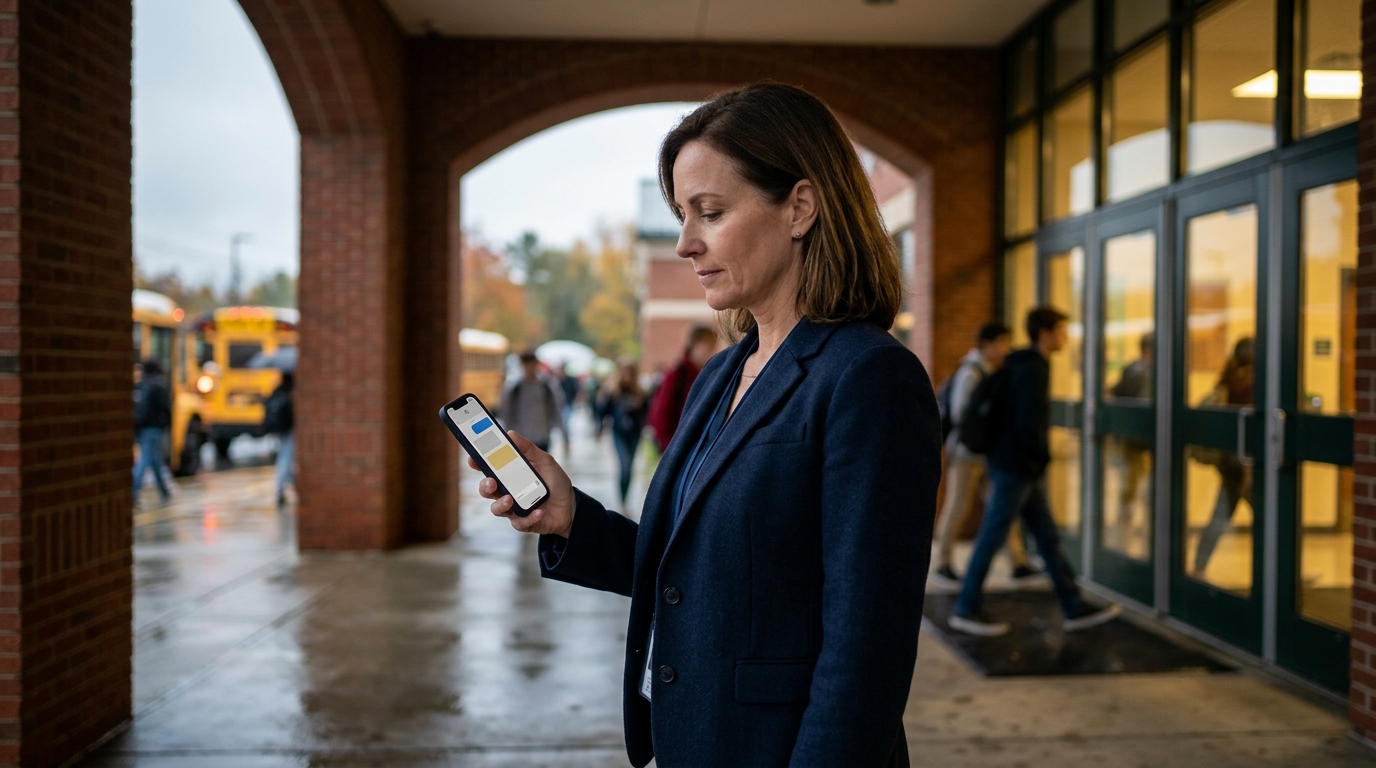
Yes, a school emergency notification system can work entirely by text message without requiring an app. BluePoint Alert Solutions uses the Command & Control platform to send automated SMS, email, and voice alerts directly to standard mobile devices. This guide covers how text-first platforms operate, why they outperform app-based systems during crises, and how to evaluate reliability, compliance, and response speed for your district.
Text-First Notification Mechanics
A text-first notification system is a communication architecture that prioritizes SMS and standard mobile protocols over proprietary software installations. This approach ensures that alerts reach any device with a cellular signal, regardless of the operating system or app store status. In high-stress environments, the absence of a login screen or download prompt is a critical safety feature.
Automated SMS and Voice Delivery
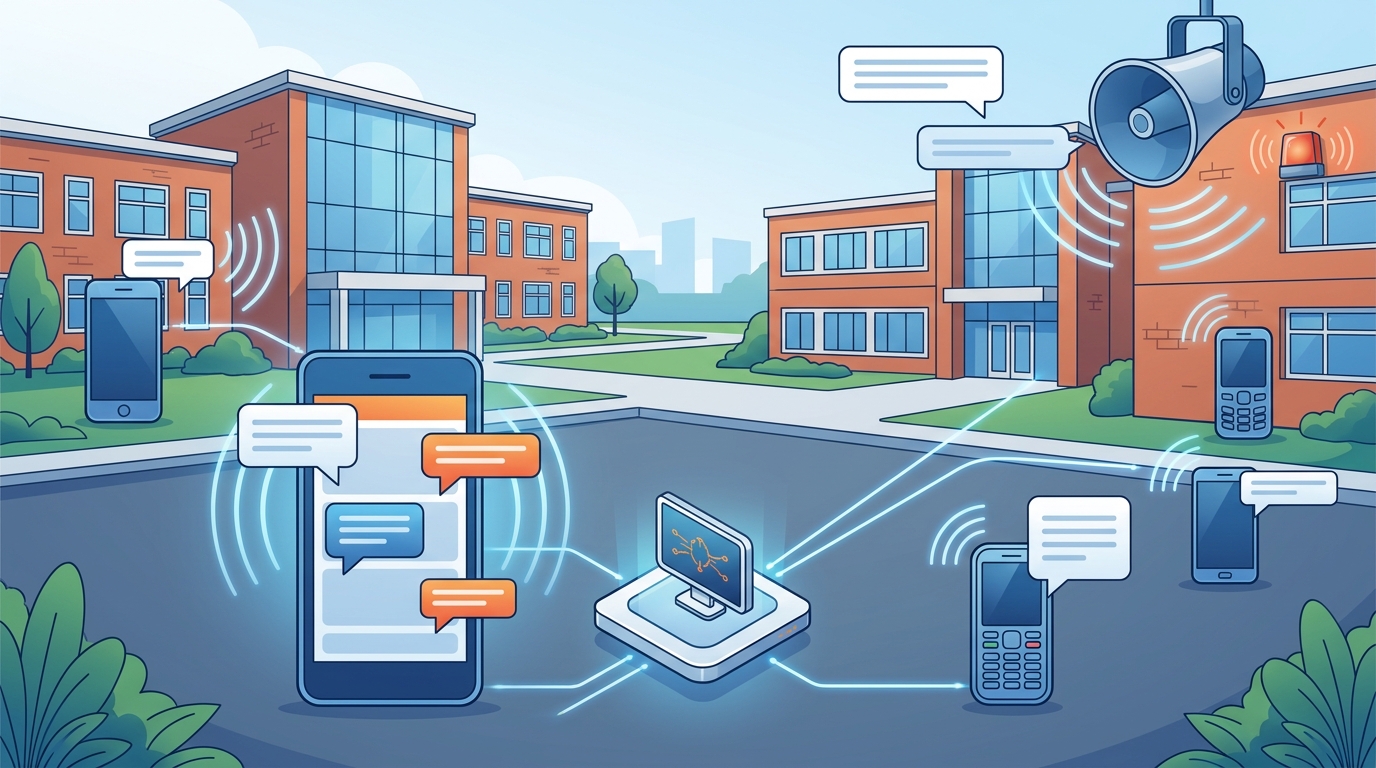
When a physical pull station or wearable device is activated, the system triggers an immediate broadcast. BluePoint Alert Solutions sends these alerts via SMS, email, and automated voice calls simultaneously. This multi-channel approach ensures that if one network is congested, another channel may still deliver the message. The alerts include precise location data, such as the specific building and floor, which is vital for first responders.
Two-Way Interactive Communication
Modern text-first systems are not one-way broadcasts. They enable two-way communication, allowing building occupants to reply with their status. For example, a teacher can text "I am safe" or "Need help" directly to the command center. This interactive layer provides real-time situational awareness without requiring complex software interfaces. It transforms a simple text message into a dynamic incident management tool.
Why App-Based Systems Fail in Emergencies
App-based notification systems rely on users having a specific application installed and active on their devices. This dependency creates significant vulnerabilities during a crisis. If a device is in "Do Not Disturb" mode, low power mode, or if the app has been updated and requires a restart, the alert may not be delivered or seen.
The Friction of Installation and Login
Requiring staff, students, and parents to download an app introduces friction that reduces adoption rates. In a district of 5,000 students, even a 10% non-adoption rate means 500 families are not receiving critical alerts. Text messages, by contrast, have near-universal reach. They do not require user action to receive, only a valid phone number in the system database.
Network Congestion and Battery Drain
During a mass emergency, cellular networks can become congested. Proprietary apps often consume more data and battery life than standard SMS. In a prolonged incident, a device running a heavy app may die faster than one sending simple text messages. Text-first systems are engineered to be lightweight, ensuring that the core alert reaches the device even under suboptimal network conditions.
The BluePoint Command & Control Platform
BluePoint Alert Solutions integrates its hardware with the Command & Control (C2) platform to deliver this text-first capability. The C2 platform is a cloud-based incident management system that orchestrates notifications, live mapping, and two-way communication. It is designed to work with the BluePoint Police Alert and Medical Alert pull stations, as well as wearable mobile pendants.
Instant Activation and Dispatch
When a BluePoint device is activated, the central station receives the signal and immediately contacts the predetermined law enforcement agency. Simultaneously, the C2 platform sends automated texts and emails to designated responders and administrators. This happens in seconds, bypassing the need for a human to dial 911 or log into a portal. The system provides the building name, address, and device type to responders, ensuring they arrive with context.
Live Mapping and Video Integration
The C2 platform includes live floor plans and security camera links. Responders can view the exact location of the activation on a digital map. They can also access live video feeds from on-premises cameras. This visual intelligence is delivered through the same mobile interface that receives the text alerts, creating a unified command center experience for administrators and first responders.
Reliability, Redundancy, and Compliance
Reliability is the cornerstone of any life-safety system. BluePoint Alert Solutions replicates the technical requirements of fire alarm systems to ensure maximum uptime. The system uses redundant communication pathways, including cellular failover and wired ethernet options. If the primary network fails, the backup battery and secondary communication path ensure the alert is still transmitted.
UL and FM Certified Monitoring
The central station monitoring for BluePoint systems is UL-listed and FM-approved. This certification ensures that the monitoring facilities meet strict standards for power redundancy, data backup, and physical security. The communication systems are rated at 99.999% availability, with less than five minutes of downtime per year. This level of reliability is critical for systems that must function during off-hours and holidays.
Security and Data Privacy
The Command & Control platform uses enterprise-level encryption and multi-factor authentication. Only authorized personnel can access system controls or view sensitive incident data. This security posture protects the privacy of students and staff while ensuring that the system remains secure from unauthorized disabling or tampering. Compliance with ADA requirements is also built into the device design, ensuring accessibility for all users.
Implementation, Testing, and Training
Implementing a text-first system requires careful planning to ensure that all contact lists are accurate and that devices are installed in strategic locations. BluePoint partners with licensed integrators to handle the installation process. Typical installations for standard setups can be completed within one to three days, minimizing disruption to the school day.
Quarterly Testing Protocols
Regular testing is essential to verify system functionality. BluePoint recommends testing the system at least quarterly. This includes activating a test device to verify that the central station receives the signal and that the automated texts and emails are delivered to the designated recipients. Testing also verifies that the two-way communication channel is open and responsive.
Training for Staff and Students
While the activation of the system is designed to be simple and intuitive, training is still important. Staff should be trained on when to activate the system and how to use the two-way text features. Students should be aware of the strobe lights and audio messaging that accompany a police alert. This familiarity reduces panic and ensures that the community responds appropriately when an emergency occurs.
Platform Comparison: Text-First vs. App-Based
| Feature | Text-First (BluePoint C2) | App-Based Systems |
|---|---|---|
| Device Requirement | Standard mobile phone (SMS/Email) | Proprietary App Installed |
| Adoption Barrier | Low (No download required) | High (Download and Login required) |
| Two-Way Communication | Yes (SMS/Email replies) | Yes (In-app chat) |
| Network Dependency | Cellular/Wired (Redundant) | Wi-Fi/Cellular (App dependent) |
| Battery Impact | Minimal | High (Background processes) |
| Live Video Integration | Yes (Via C2 Portal) | Varies by App |
Key Takeaways
- Text-first systems eliminate the friction of app downloads, ensuring higher adoption rates among staff, students, and parents.
- BluePoint Alert Solutions uses the Command & Control platform to send automated SMS, email, and voice alerts in seconds.
- Two-way text communication allows occupants to report their status, providing real-time situational awareness to the command center.
- Redundant communication pathways and UL/FM certified monitoring ensure 99.999% system availability.
- App-based systems are vulnerable to "Do Not Disturb" modes, battery drain, and network congestion during mass alerts.
- Quarterly testing is recommended to verify that automated alerts are delivered and that two-way channels are functional.
- Integration with live mapping and security cameras provides first responders with critical context upon arrival.
- Simple, intuitive activation devices, such as pull stations and wearables, require no training to use in a crisis.
Frequently Asked Questions
Does BluePoint require an app for parents to receive alerts?
No. BluePoint Alert Solutions sends alerts via SMS text, email, and automated voice calls. Parents and guardians do not need to download a proprietary app to receive critical emergency notifications.
How fast are the text messages sent after activation?
Alerts are sent in seconds. When a device is activated, the central station receives the signal and immediately triggers the automated notifications to all designated contacts via the Command & Control platform.
Can teachers reply to the text messages during an emergency?
Yes. The system supports two-way communication. Teachers and staff can reply to the automated texts with their status, such as "I am safe" or "Need help," which is visible to the command center.
What happens if the school's internet goes down?
BluePoint systems use redundant communication pathways, including cellular failover. The devices have backup batteries and can transmit alerts via cellular networks even if the primary wired network fails.
Is the system compliant with ADA requirements?
Yes. BluePoint devices are designed with accessibility in mind, including proper mounting heights, tactile feedback, and visual indicators to meet ADA requirements where applicable.
How often should we test the notification system?
Regular testing is recommended at least quarterly. This ensures that the devices are functional, the communication pathways are active, and the contact lists are up to date.
Can the system notify law enforcement directly?
Yes. When a Police Alert device is activated, the central station immediately contacts the predetermined law enforcement agency. This bypasses the need for a human to call 911, ensuring a faster response.
Conclusion
For school administrators and safety officers, the choice of notification platform is a critical decision that impacts the safety of the entire community. A text-first system like the one offered by BluePoint Alert Solutions provides the reliability, speed, and accessibility that app-based systems often lack. By leveraging the Command & Control platform, districts can ensure that every second counts in an emergency. To explore how a text-first emergency response system can fit your district's specific needs, to schedule a demonstration.