

Self-Installed Medical Alert Systems for Manufacturing Facilities
Yes, there is a medical alert system for manufacturing facilities that can be self-installed. RapidAlert by BluePoint Alert Solutions is engineered specifically for EHS and occupational safety teams to deploy without professional contractors. This guide covers the technical requirements for self-deployment, the role of wearable panic buttons, wireless coverage strategies for large industrial footprints, fall detection capabilities, and the cellular connectivity standards that ensure 24/7 reliability in high-noise, high-interference environments.
Self-Installation Requirements
Traditional life-safety systems often require licensed electricians or specialized security integrators for installation, which increases cost and lead time. A self-installable medical alert system is a device that allows facility safety managers to configure and deploy hardware without external technical support. BluePoint Alert Solutions designed the RapidAlert unit to be self-installed by EHS teams, removing the dependency on third-party contractors for basic deployment.
Hardware and Power Specifications
The RapidAlert unit utilizes a standard plug-in transformer for a standard duplex receptacle. This design choice is critical for self-installation because it eliminates the need for hardwired electrical connections. The device includes an integral battery backup that is supervised for low battery status, ensuring uninterrupted service during power outages. The device is supervised for AC loss, meaning the system automatically reports if the primary power source is disconnected.
Activation and Reset Protocols
Activation is modeled after a standard fire alarm pull station. The user pushes in and pulls down to activate the device. This familiar interface requires no specialized training for activation, which is a significant advantage in high-stress emergency scenarios. The device stays latched until it is reset with a key. This physical reset mechanism prevents accidental re-activation or unauthorized tampering, a critical security feature for industrial environments where devices may be exposed to accidental impact.
Communication Setup
Communication is handled via a cellular dual SIM primary pathway. An optional wired ethernet connection is available for facilities that prefer a hardwired backup. The system is supervised for communication trouble, alerting administrators if the cellular signal is lost. This level of supervision ensures that the self-installed system remains visible to the safety team at all times, providing the same reliability as a professionally monitored system.
Wearable Panic Buttons
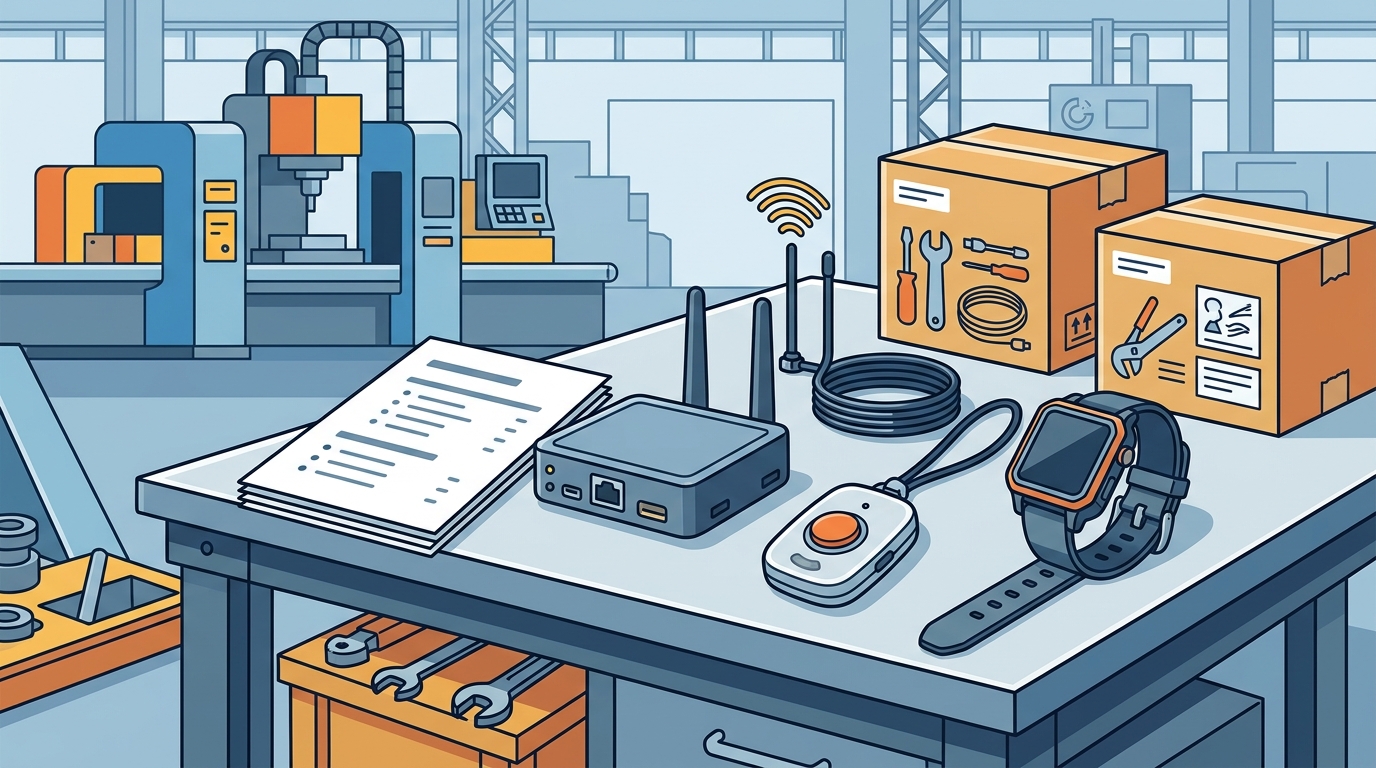
Fixed pull stations are effective, but they are static. In a manufacturing facility, workers are constantly moving between production lines, warehouses, and office areas. A wearable panic button is a portable activation device that allows a worker to trigger an alert from anywhere within the facility. BluePoint Alert Solutions includes wearable mobile pendants alongside standard pull stations to provide comprehensive coverage.
Portability and Accessibility
Wearable devices enable individuals moving around the building to activate the system quickly and securely if they encounter an active threat or witness a medical emergency. This is particularly important in large industrial structures where the nearest fixed pull station may be several hundred feet away. The pendants act as a portable panic button solution, ensuring that the response time is not dictated by the worker's physical location relative to the hardware.
Integration with Command and Control
When a wearable device is activated, it triggers the same Command & Control (C2) platform as the fixed units. The C2 platform orchestrates on-site communication and delivers real-time situational awareness through live maps and floor plans. This integration ensures that the location of the wearable activation is immediately visible to the response team, allowing them to navigate to the exact point of the incident without delay.
Wireless Manufacturing Coverage
Manufacturing facilities present unique challenges for wireless communication. High ceilings, metal structures, and heavy machinery can create dead zones for standard Wi-Fi or Bluetooth signals. A wireless manufacturing coverage strategy is a plan for ensuring that alert signals can be transmitted and received reliably across the entire facility footprint.
Signal Propagation in Industrial Environments
Standard consumer-grade wireless signals often struggle in industrial settings due to signal attenuation caused by metal walls and equipment. BluePoint systems use redundant communication pathways to mitigate this risk. The primary pathway is cellular, which generally has better penetration in large structures than local Wi-Fi networks. The optional wired ethernet connection provides a hardwired fallback for critical nodes where cellular signal strength may be inconsistent.
Strategic Device Placement
Effective coverage requires strategic placement of activation and notification devices. Pull stations should be located in areas with higher risk of medical emergencies, such as lunch areas, manufacturing production areas, gyms, and nurse offices. Strobe lights and audio messaging devices should be placed to ensure that all occupants are notified, even in high ambient noise areas. The C2 platform provides live location mapping, which helps responders understand the exact location of the incident within the complex facility layout.
Fall Detection
While the primary function of the RapidAlert system is manual activation, the broader ecosystem of medical alert technology is evolving to include automated detection. Fall detection is a feature that uses sensors to identify when a person has fallen and automatically triggers an alert. In manufacturing facilities, falls from height or slips on production floors are significant safety risks.
Manual vs. Automated Response
Currently, the RapidAlert system relies on manual activation by the worker or a bystander. This is a deliberate design choice to ensure that the alert is intentional and to avoid false positives that could disrupt operations. However, the C2 platform is designed to integrate with various sensors and third-party systems. As fall detection technology matures, these automated triggers can be integrated into the existing C2 framework to provide a layered safety net.
Operational Considerations
Implementing automated fall detection in a manufacturing environment requires careful consideration of false positives. Heavy machinery and dynamic work environments can generate sensor data that mimics a fall. Therefore, any automated detection system must be calibrated specifically for the industrial context. The C2 platform's ability to provide real-time two-way communication allows responders to verify the situation before dispatching emergency services, reducing the risk of unnecessary response.
Cellular Connectivity
Reliable communication is the backbone of any emergency response system. Cellular connectivity is the primary communication method for the RapidAlert system, ensuring that alerts are transmitted even if the facility's local network is down. BluePoint systems use a cellular dual SIM primary pathway, which provides redundancy and ensures that the alert is sent even if one carrier experiences an outage.
Redundancy and Failover
The dual SIM configuration allows the device to switch between carriers automatically if the primary signal is lost. This is critical in industrial environments where signal strength can fluctuate. The system is supervised for communication trouble, meaning that if the device cannot establish a connection, the safety team is notified. This proactive monitoring ensures that the system is always ready to transmit an alert when needed.
Integration with PSAP Dispatch
RapidAlert units can be configured to make a dispatch request to the local public safety answering point (PSAP). This ensures that professional responders are notified with precise location and incident context from the moment of activation. The C2 platform connects directly to PSAP dispatch, providing responders with the information they need to respond effectively. This integration is a key differentiator for BluePoint systems, as it bridges the gap between on-site response and professional emergency services.
Key Takeaways
- RapidAlert is a self-installable medical alert system designed for EHS teams, eliminating the need for professional contractors.
- The system uses a standard plug-in transformer and integral battery backup, simplifying power requirements.
- Wearable panic buttons provide portable activation capabilities, ensuring coverage in large, dynamic manufacturing environments.
- Cellular dual SIM connectivity provides redundant communication pathways, ensuring reliable alert transmission.
- The Command & Control platform offers real-time situational awareness through live maps and two-way communication.
- Strategic placement of pull stations and strobes is essential for effective coverage in industrial facilities.
- The system is supervised for power, battery, and communication status, ensuring continuous readiness.
- Integration with PSAP dispatch ensures that professional responders are notified with precise incident context.
Frequently Asked Questions
Can the RapidAlert system be installed without a licensed electrician?
How does the system handle power outages?
The device includes an integral battery backup that is supervised for low battery status. This ensures uninterrupted service during power outages. The system is also supervised for AC loss, alerting administrators if the primary power source is disconnected.
Is the system suitable for large manufacturing facilities?
Yes. The system is designed for industrial environments. It uses cellular dual SIM connectivity for reliable communication and includes wearable panic buttons for portable activation. The C2 platform provides live location mapping, which is essential for navigating large, complex facility layouts.
Does the system require a smartphone app to function?
No. The system sends automated text, email, and voice communications to designated response teams. No app or login is required for the recipients to receive alerts. This ensures that the right people are notified instantly, regardless of their device preferences.
How is the device reset after an activation?
The device stays latched until it is reset with a key. This physical reset mechanism prevents accidental re-activation or unauthorized tampering. It is a critical security feature for industrial environments where devices may be exposed to accidental impact.
Can the system be integrated with existing security cameras?
Yes. The C2 platform can provide live security camera links to select individuals during an emergency. This real-time information is crucial for an effective response by building occupants and first responders. It allows the command group to view the incident location and assess the situation before dispatching responders.