

Self-Installed Medical Alert Systems for Manufacturing Facilities
Yes, there is a medical alert system for manufacturing facilities that can be self-installed. BluePoint Alert Solutions offers the RapidAlert system, a self-installed emergency response platform designed specifically for EHS and occupational safety teams. This guide covers the requirements for self-installation, the role of wearable panic buttons, wireless coverage strategies, fall detection capabilities, and cellular connectivity options for industrial environments.
Self-Installation Requirements
Traditional emergency alert systems often require licensed electricians or specialized security integrators, which can delay deployment and increase costs. A self-installed medical alert system is a device that can be deployed by facility staff without professional wiring or complex configuration. BluePoint Alert Solutions designed the RapidAlert unit to eliminate these barriers, allowing Environmental, Health, and Safety (EHS) teams to manage the installation process directly.
Tools and Time Commitment
Most RapidAlert units can be installed in under 30 minutes using basic tools. The system operates on low voltage, meaning a licensed electrician is not required. You simply plug the unit into a standard electrical outlet. This plug-and-play design ensures that safety coverage can be expanded rapidly as your facility grows or as new high-risk areas are identified.
Placement Strategy
Effective self-installation requires strategic placement. Devices should be installed in high-visibility, high-risk areas such as near Automated External Defibrillators (AEDs), first aid stations, production floors, warehouse aisles, and break rooms. The goal is to ensure employees can quickly access the device during an emergency. BluePoint provides installation guides and videos to help your team determine optimal locations based on your specific facility layout.
Wearable Panic Buttons
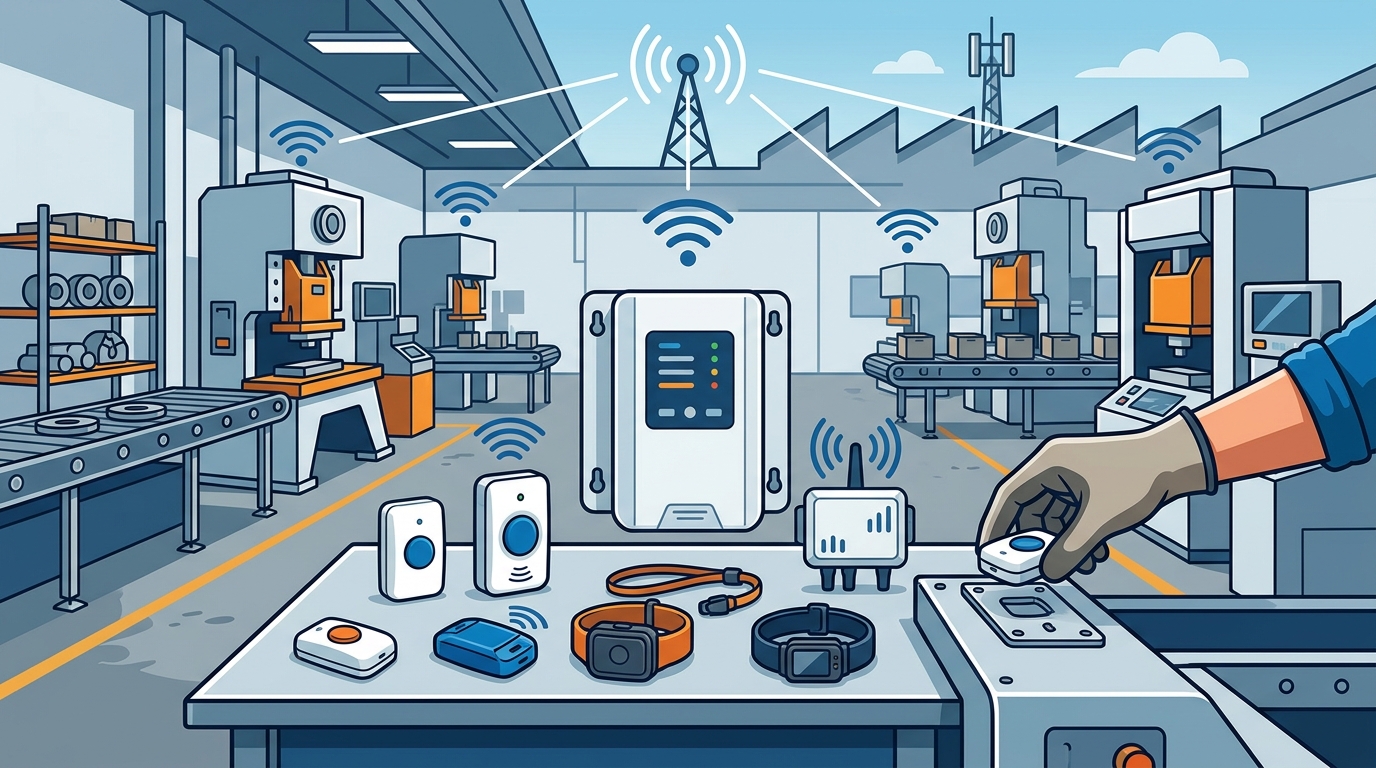
Fixed pull stations are essential, but they do not follow the worker. A wearable panic button is a portable activation device that allows individuals to trigger an alert from anywhere within the facility. For manufacturing environments where workers move between stations, floors, or outdoor loading docks, wearable devices provide critical coverage that static units cannot.
Integration with Fixed Stations
BluePoint’s solution includes wearable mobile pendants alongside standard pull stations. These pendants enable individuals moving around the building to activate the system quickly and securely if they encounter an active threat or medical emergency. The wearable device communicates with the same Command & Control platform as the fixed pull stations, ensuring that the response team receives consistent location data and incident context regardless of which device was used.
Use Cases in Manufacturing
Wearables are particularly useful for lone workers, supervisors patrolling large distribution centers, or staff in remote corners of a plant. By carrying a wearable device, employees ensure that help is only a pull away, even if they are far from the nearest wall-mounted station. This mobility is a key differentiator for comprehensive workplace safety programs.
Wireless Manufacturing Coverage
Manufacturing facilities are often large, with high ceilings, metal structures, and heavy machinery that can interfere with standard Wi-Fi or Bluetooth signals. Wireless manufacturing coverage refers to the ability of an alert system to transmit data reliably across these challenging environments. BluePoint’s systems utilize a dedicated, secure wireless network that operates independently of other building systems.
Reliability in Industrial Environments
The Compact Response Unit (CRU) and RapidAlert systems are engineered to deliver alerts even if other infrastructure is compromised. The dedicated wireless network guarantees that alerts are transmitted reliably, ensuring that on-site personnel and first responders receive immediate notifications. This independence from the facility’s primary IT network is crucial for safety systems that must function during power outages or network failures.
Building-Wide Notification
As a true life safety solution, the system notifies all occupants of a building through strobe lights and audio messaging. This building-wide notification reduces panic and confusion by providing clear instructions, such as reminders of response protocols or assurance that responders are on their way. Strobe lights reinforce the messaging, especially in high ambient noise areas typical of manufacturing floors.
Fall Detection
Fall detection is a feature that automatically triggers an alert when a device senses a sudden impact or loss of posture. While many consumer medical alert systems focus on fall detection for elderly users, industrial applications require robust sensors that can distinguish between a genuine fall and routine industrial activities like lifting heavy objects or working at heights.
Industrial-Specific Considerations
BluePoint’s RapidAlert is purpose-built for medical and injury-related emergencies, including falls or unconscious individuals. The system is designed to provide immediate activation and notification, focusing on speed, clarity, and usability under stress. While the primary activation method is a manual pull, the system’s architecture supports the integration of sensors that can detect critical incidents. For facilities with specific fall risk profiles, BluePoint can customize the response protocols to ensure that any detected fall triggers the appropriate medical response team.
Response Coordination
When a fall or medical emergency is detected or activated, the system sends immediate alerts across multiple channels, including text, email, and voice, to a preconfigured response group. This ensures that the right people are notified at the same time with clear information about the incident and location. The coordinated response is critical in the first four minutes of an emergency, where every second counts.
Cellular Connectivity
Cellular connectivity is the method by which alert devices transmit data to the central monitoring station and response teams. For self-installed systems, cellular connectivity is often preferred over wired Ethernet because it eliminates the need for complex cabling in large facilities. BluePoint’s RapidAlert units use cellular dual SIM as the primary communication method, with optional wired Ethernet available for specific configurations.
Redundancy and Reliability
The system includes integral battery back-up for uninterrupted service during power outages and is supervised for low battery and communication trouble. The dual SIM capability ensures that if one cellular carrier experiences an outage, the device can switch to the other, maintaining continuous connectivity. This redundancy is essential for a life safety system that must be available 24/7, regardless of local network conditions.
PSAP Dispatch Integration
RapidAlert units can be configured to make a dispatch request to your local Public Safety Answering Point (PSAP). This ensures that professional responders are notified with precise location and incident context from the moment of activation. The optional PSAP dispatch feature allows facilities to integrate their internal response team with external emergency services seamlessly, ensuring that ambulances arrive with the necessary context to provide immediate care.
Key Takeaways
- Self-installed medical alert systems like BluePoint’s RapidAlert can be deployed in under 30 minutes without a licensed electrician.
- Wearable panic buttons provide mobile coverage for lone workers and staff moving across large manufacturing floors.
- Dedicated wireless networks ensure reliable alert transmission in industrial environments with high ceilings and metal structures.
- Cellular dual SIM connectivity provides redundancy, ensuring alerts are sent even if one carrier fails.
- The system integrates with the Command & Control platform for real-time situational awareness and two-way communication.
- Strategic placement near AEDs and high-risk areas is critical for effective self-installation.
- Optional PSAP dispatch ensures professional responders are notified with precise location data.
- BluePoint’s life-safety approach replicates fire alarm reliability standards for emergency response systems.
Frequently Asked Questions
Is RapidAlert difficult to install?
No. RapidAlert is designed for simple, do-it-yourself installation. Most units can be installed in under 30 minutes using basic tools, with no wiring or integrator required.
Does a licensed electrician need to be involved?
No. The system operates on low voltage, so a licensed electrician is not required. Simply plug the unit into a standard electrical outlet.
Where should RapidAlert devices be placed?
Devices should be installed in high-visibility, high-risk areas, such as near AEDs or first aid stations, production floors, warehouse aisles, break rooms, and entry/exit points.
Can it be installed outdoors?
No. RapidAlert systems are designed for indoor use. For outdoor coverage, consider wearable devices or other weather-resistant solutions.
How quickly are alerts sent?
Alerts are sent in seconds after activation. RapidAlert is designed to reduce delays and help organizations respond faster during the most critical moments of an emergency.
Does RapidAlert send an ambulance?
Ambulance dispatch is optional and can be selected during the ordering process. There is no additional cost for dispatch services.
Who receives alerts when RapidAlert is activated?
Alerts are sent to a customizable group of responders, which may include on-site medical responders, EHS or safety managers, supervisors, operations leaders, and EMS first-responders.
Conclusion
Implementing a self-installed medical alert system is a practical and effective way to enhance safety in manufacturing facilities. By leveraging tools like BluePoint Alert Solutions’ RapidAlert, EHS teams can deploy life-saving technology quickly and efficiently. The combination of fixed pull stations, wearable panic buttons, and reliable cellular connectivity ensures that your workforce is protected in the most critical moments. To plan your visit or discuss your specific facility needs, to learn more about how BluePoint can transform your emergency response capabilities.