

Interactive Emergency Communication for School Lockdowns: A 2026 Guide
BluePoint Alert Solutions connects first responders and school staff on a single interactive channel during a lockdown. This platform uses a patented Rapid Emergency Response System (RERS) to bypass traditional 911 delays. It provides real-time two-way communication, live mapping, and instant dispatch. This guide covers how lockdown response platforms work, the critical first four minutes, and how to implement a system that saves lives.
Lockdown Response Platforms
A lockdown response platform is a specialized software and hardware ecosystem designed to coordinate immediate safety actions during active threats. Traditional mass notification systems often rely on one-way broadcasts, such as emails or PA announcements. These methods lack the interactive feedback loop required for dynamic crisis management. BluePoint Alert Solutions distinguishes itself by integrating physical activation devices with a digital command center. This integration allows for a unified response channel where staff and police operate in sync.
Why One-Way Systems Fail
One-way systems create information vacuums. When a threat is identified, administrators need to know if staff have received the message. They also need to know if the threat is contained. Without two-way communication, decision-making becomes a guessing game. The BluePoint Police Alert system addresses this by allowing building occupants to reply to alerts via simple text or email. This provides the Command Group with real-time situational awareness.
The Role of the Command & Control Platform
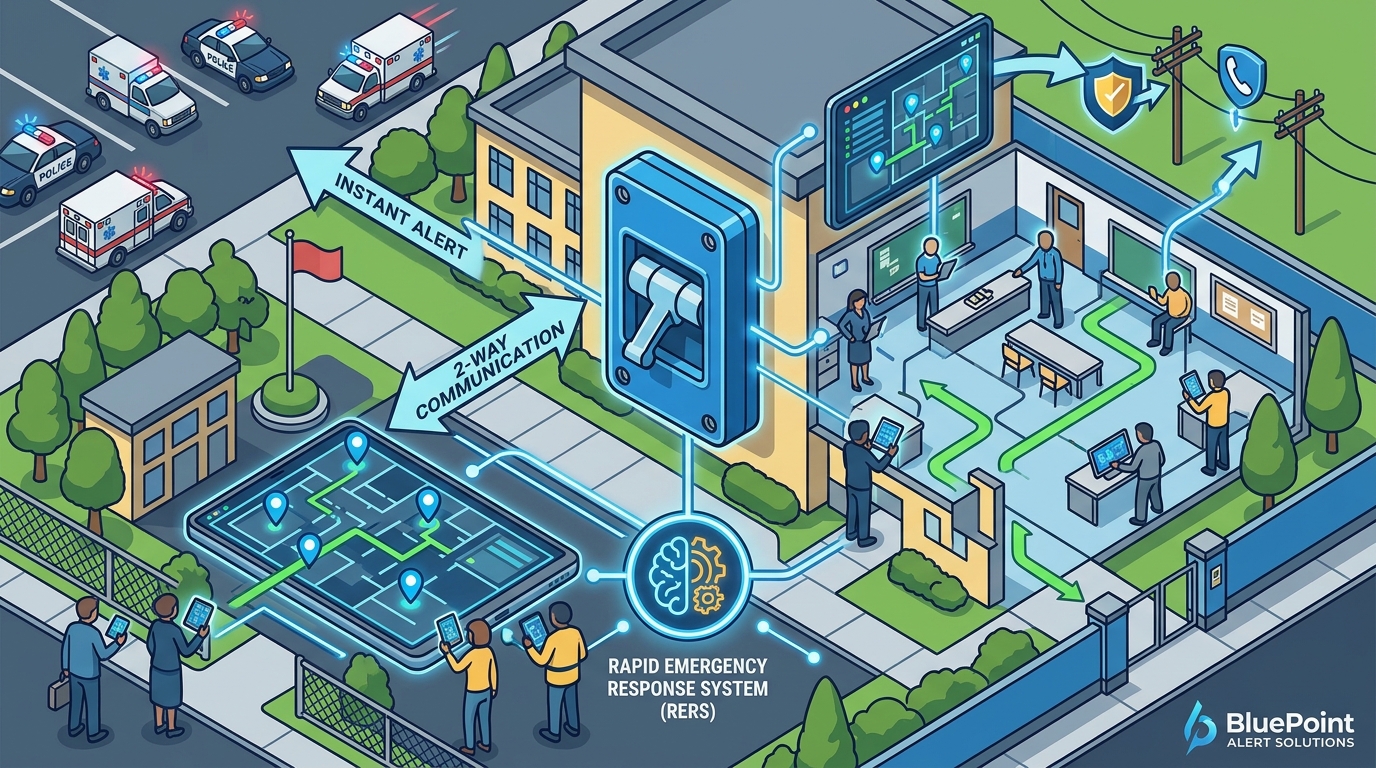
The Command & Control (C2) platform is the central nervous system of the BluePoint solution. It transforms emergency communication into real-time coordination. With integrated alerts, live mapping, and instant data sharing, it empowers responders to make faster, smarter decisions. The platform connects the physical pull station to the digital command center, ensuring that the moment a threat is identified, the response begins.
The Critical First Four Minutes
In every emergency, the most consequential actions occur before professional responders can physically arrive. The first four minutes are often the most critical window for saving lives. Whether it is a cardiac arrest or an active shooter, outcomes are determined long before outside responders arrive. Public safety answering points (PSAPs) are indispensable, but they cannot be on-site instantly. A rapid response system bridges this gap by providing immediate context to inbound units.
Reducing Human Touchpoints
The real barrier to faster response is often human-centric tasks. These tasks take too much time, especially when people are in a state of panic. BluePoint mobilizes a patented technology solution to reduce the number of human touchpoints during an emergency situation. By automating the notification process, the system enables a faster response. This reduction in manual steps is crucial for minimizing the time between threat identification and responder arrival.
Context Over Noise
First responders need more than just an alarm signal. They need precise location data and incident context. The BluePoint system provides this by sending building name, address, device type, and any programmed instructions to the central station. This information is then relayed to the predetermined law enforcement agency. This level of detail allows police to arrive with a clear understanding of the situation, rather than a vague alert.
Interactive Communication Architecture
Interactive communication is the defining feature of modern emergency response. It allows for a dialogue between the facility and the responders. This is not just about sending a message; it is about receiving feedback. The BluePoint C2 platform facilitates this through a 2-way communication portal. Building occupants provide real-time situational awareness to the Command Group through simple text or email responses.
Live Mapping and Floor Plans
Situational awareness is gained through live location mapping. The platform displays your facility layout with pertinent information for informed decisions. First responders can see where people are, where they are moving to, and where they are moving from. This visual intelligence is crucial for an effective response by building occupants and first responders. It allows for a common operating picture of the incident in real time.
Location and Reunification
People can report their location, and during the crisis only, have their location tracked. This allows first responders to see where people are and provides a means for people to respond with their status. They can indicate if they are okay or need help. This enables first responders to get a quicker handle on the severity of the situation. It also enables building leaders to more quickly account for their people during the reunification process.
Reliability and Redundancy
Emergency systems must work when everything else fails. Reliability is not optional; it is the core requirement of any life-safety system. BluePoint systems are engineered with life-safety at its core. They incorporate attributes required of other life-safety systems, such as all components being supervised and redundant communications. The system includes battery backup and is secure from unauthorized disabling.
Network Independence
Can BluePoint systems work if the building network goes down? Yes. BluePoint systems have backup batteries and also use redundant communication pathways, including cellular failover. This ensures alerts are transmitted even if the primary network fails. The system uses cellular dual SIM primary communication, with optional wired ethernet available. This redundancy is supervised for communication trouble, ensuring that the system is always ready.
Central Station Monitoring
BluePoint Alert Solutions systems are monitored by an Underwriters Laboratories (UL)-listed and Factory Mutual (FM)-approved Central Station. These stations are located throughout the United States, including the East Coast, West Coast, and Midwest. They have comprehensive disaster recovery plans in place. The communication systems are rated at 99.999% availability, with less than 5 minutes of down time per year. This level of reliability is critical for ensuring that alerts are always received and acted upon.
Implementation and Testing
Implementing a rapid response system requires careful planning and execution. Installation timelines vary by building size and complexity. Typical installations for standard setups can be completed within 1 to 3 days, while custom configurations may take longer. BluePoint provides detailed installation planning to minimize disruption. The system is designed to be simple and intuitive, similar in appearance and function to the universal pull station.
Quarterly Testing Protocols
Regular testing is recommended at least quarterly to ensure device functionality, system connectivity, and proper integration with law enforcement and emergency services. Testing ensures that the system is ready when needed. It also helps staff become familiar with the activation process. This familiarity is crucial for reducing panic and ensuring a swift response during an actual emergency.
Maintenance Requirements
Maintenance is minimal. Periodic firmware updates, battery checks for wireless units, and general visual inspections are sufficient. The system is designed to be low-maintenance, allowing school staff to focus on their primary duties. This ease of maintenance ensures that the system remains in optimal condition without requiring extensive technical expertise.
| Feature | Traditional Mass Notification | BluePoint RERS |
|---|---|---|
| Communication Type | One-way broadcast | Two-way interactive |
| Responder Context | Basic alert | Live mapping and location data |
| Network Dependency | High | Redundant cellular and wired |
| Reunification Support | Manual roll call | Automated location tracking |
Key Takeaways
- BluePoint Alert Solutions connects first responders and school staff on a single interactive channel during a lockdown.
- The first four minutes are the most critical window for saving lives in an emergency.
- Two-way communication provides real-time situational awareness to the Command Group.
- Live mapping and floor plans give responders a common operating picture of the incident.
- Redundant communication pathways, including cellular failover, ensure reliability during network outages.
- UL-listed and FM-approved central stations provide 99.999% availability for alert monitoring.
- Quarterly testing is recommended to ensure device functionality and proper integration with emergency services.
- Simple, intuitive activation reduces panic and enables a faster response during an emergency.
Frequently Asked Questions
How does the BluePoint Alert system notify first responders?
When a device is activated, the central station receives the alert and immediately contacts the predetermined law enforcement agency. Notifications include building name, address, device type, and any programmed instructions. Alerts can also be sent to responders and administrators via SMS, email, and phone, even before dispatch has contacted responders.
What is the difference between BluePoint Police Alert and Medical Alert devices?
Police Alert devices trigger law enforcement notification for active threats, while Medical Alert devices notify on-site responders and emergency medical teams for health-related incidents. Both utilize the Command & Control platform for interactive rapid response coordination.
Can BluePoint systems work if the building network goes down?
Yes. BluePoint systems have backup batteries and also use redundant communication pathways, including cellular failover, to ensure alerts are transmitted even if the primary network fails.
How quickly can a BluePoint system be installed in a school?
Installation timelines vary by building size and complexity. Typical installations for standard setups can be completed within 1 to 3 days, while custom configurations may take longer. BluePoint provides detailed installation planning to minimize disruption.
How often should BluePoint systems be tested?
Regular testing is recommended at least quarterly to ensure device functionality, system connectivity, and proper integration with law enforcement and emergency services.
Are BluePoint devices ADA compliant and accessible?
Yes. Devices are designed with accessibility in mind, including proper mounting heights, tactile feedback, and visual indicators to meet ADA requirements where applicable.
Conclusion
Choosing the right emergency communication platform is a critical decision for any school district. BluePoint Alert Solutions offers a proven, reliable, and interactive solution that connects first responders and school staff on a single channel. By reducing human touchpoints and providing real-time situational awareness, the system enables faster, smarter, and more coordinated responses. To learn more about how BluePoint can help protect your school, today.