

Yes, a school emergency notification system can work entirely via text message without requiring an app. BluePoint Alert Solutions provides a text-first architecture that sends instant SMS alerts to staff, parents, and first responders. This guide covers how to choose, verify, and implement a text-based system that ensures rapid, reliable communication during critical incidents.
How to Choose a Text-First System
Selecting a notification platform requires looking beyond basic messaging features. A robust system must prioritize delivery speed and redundancy. Text-first architecture is a communication model that relies on SMS as the primary channel, ensuring reach without software installation. When evaluating vendors, look for systems that integrate with existing infrastructure like fire alarms and access control. BluePoint Alert Solutions emphasizes a "True Life Safety" approach, where the system is simple, intuitive, and building-wide. Avoid platforms that treat text as an afterthought to a mobile app. The core value lies in the immediacy of the alert and the ability to receive two-way responses via text.
Reliability Over Features
Feature-rich apps often fail when networks are congested. SMS is a legacy protocol with high penetration. A good system ensures that if the primary network fails, a backup pathway exists. Check for redundant communication pathways, such as cellular failover, which are critical for maintaining uptime during a crisis.
Questions to Ask Before Committing
Before signing a contract, you must interrogate the vendor's technical capabilities. Ask how the system handles network congestion during a mass alert. Inquire about the latency between activation and message delivery. You should also ask about the integration with local law enforcement. Does the system bypass 911 to notify police directly? BluePoint's systems are designed to contact predetermined law enforcement agencies immediately upon activation, providing critical context that standard 911 calls often lack.
Integration and Compatibility
Ask if the system can integrate with your existing security cameras and access control panels. Can it trigger door locks or unlock exits? These integrations are vital for a coordinated response. Ensure the vendor provides a clear roadmap for these integrations and does not lock you into proprietary hardware that is difficult to replace.
Verifying Claims and Credentials
Vendors often make bold claims about uptime and speed. You must verify these independently. Check for UL and FM certifications for the monitoring stations. Central Station Monitoring is a service where a third-party facility receives and processes alarm signals 24/7. BluePoint utilizes UL-listed and FM-approved central stations with four interconnected operating locations across the United States. Verify that the vendor's central stations have comprehensive disaster recovery plans. Do not rely solely on marketing materials; request technical documentation and case studies from similar institutions.
How the System Works in Sequence
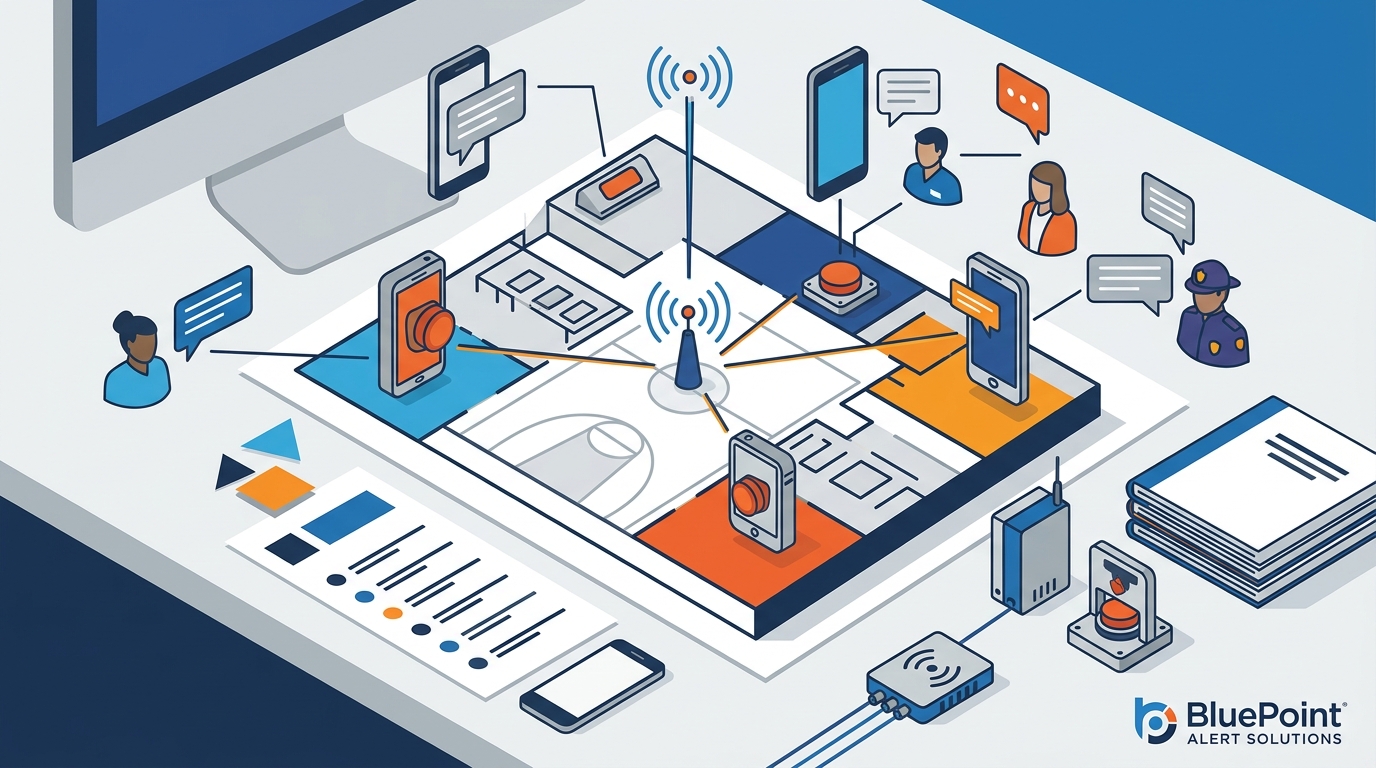
Understanding the sequence of events is crucial for trust. When a BluePoint device is activated, the central station receives the alert. It immediately contacts the predetermined law enforcement agency. Notifications include the building name, address, device type, and any programmed instructions. Simultaneously, SMS, email, and phone alerts are sent to responders and administrators. This happens in seconds, often before dispatch has contacted responders. The system provides a common operating picture, allowing for real-time coordination.
The Role of Command and Control
The Command & Control (C2) platform orchestrates the response. It provides live mapping and floor plans to responders. Building occupants can provide real-time situational awareness through simple text responses. This two-way communication allows the command group to filter information and provide faster, more informed instructions. The system is designed to reduce the number of human touchpoints during an emergency, enabling a faster response.
Cost Drivers and Budgeting
Costs for emergency notification systems vary based on scale and complexity. The primary drivers are the number of devices, the scope of the monitoring service, and the level of integration. Recurring Monitoring Fees are monthly costs paid for the 24/7 central station service and software access. One-time costs include hardware installation and initial configuration. BluePoint offers solutions that are affordable and scalable. For example, their RapidAlert platform is designed for EHS teams and offers self-installation options, which can reduce labor costs. Budget for ongoing maintenance and testing, which are essential for compliance and reliability.
Common Mistakes to Avoid
One common mistake is assuming that a system is "set and forget." Regular testing is required to ensure functionality. Another error is failing to update contact lists. If staff or parents change phone numbers, the system cannot reach them. Ensure your vendor provides an easy-to-use portal for managing contacts. A third mistake is ignoring the user experience. If the activation process is complex, people will hesitate. BluePoint devices are modeled after standard fire alarm pulls, making them intuitive for anyone to activate. Avoid systems that require complex passwords or multi-step processes for activation.
Text-First vs. App-Based Alternatives
App-based systems require users to download and maintain software. This creates a barrier to entry and potential failure points. Text-first systems leverage the universal nature of SMS. The following table compares the two approaches:
| Installation Requirement | None (Native to Phone) | App Download Required |
| Network Dependency | Cellular (High Penetration) | Wi-Fi or Cellular (Variable) |
| User Adoption | High (Universal) | Variable (Requires Onboarding) |
| Two-Way Communication | Simple Text Replies | Rich Media (Photos/Video) |
| Reliability in Congestion | High (Priority Protocol) | Lower (Data Throttling Risk) |
While apps offer rich media, text-first systems offer superior reliability and adoption. For life-safety applications, reliability is the paramount concern.
Application in Specific School Scenarios
Different scenarios require different response protocols. For active threats, the system must notify law enforcement immediately. For medical emergencies, it should notify on-site responders and medical teams. BluePoint distinguishes between Police Alert and Medical Alert devices. Police Alert devices trigger law enforcement notification for active threats. Medical Alert devices notify on-site responders for health-related incidents. This distinction ensures that the right people are notified for the right type of emergency, preventing confusion and ensuring a targeted response.
Regulatory Rules and Data Protections
Schools must comply with data privacy laws such as FERPA and COPPA. Ensure your vendor has robust security measures. Enterprise-Level Encryption is a security standard that protects data in transit and at rest. BluePoint's Command & Control platform uses enterprise-level encryption, multi-factor authentication, and secure server hosting. Verify that the vendor complies with ADA requirements for accessibility. Devices should be designed with proper mounting heights, tactile feedback, and visual indicators. Regular audits of data access and security protocols are essential to maintain trust and compliance.
Local Implementation Specifics
Implementation details can vary by region and local infrastructure. In rural areas, cellular coverage may be spotty. Ensure your system has backup communication pathways, such as satellite or wired ethernet, if available. In urban areas, network congestion is a greater risk. BluePoint systems use redundant communication pathways, including cellular failover, to ensure alerts are transmitted even if the primary network fails. Work with local integrators who understand the specific challenges of your area. BluePoint partners with licensed integrators across the country to implement and maintain their systems.
The Critical Role of Timing
Time is the most critical factor in emergency response. Every second counts. The goal is to reduce the time between the onset of an emergency and the arrival of responders. BluePoint's systems are designed to cut response times significantly. By providing immediate notification with precise location data, responders can arrive faster and with the context they need. The first four minutes are often the most critical in medical emergencies. A text-first system ensures that this window is utilized effectively, maximizing the chances of a positive outcome.
Long-Term Measurable Outcomes
Success is measured by response times and system uptime. Track the time from activation to responder arrival. Compare this to your baseline before implementation. Monitor the system's uptime and any communication failures. Regular testing, at least quarterly, ensures that the system remains functional. Over time, you should see a reduction in response times and an increase in staff confidence. BluePoint's customers report dramatic improvements in response times, with first responders providing care within minutes of an alert. These measurable outcomes demonstrate the value of a robust, text-first notification system.
Key Takeaways
- Text-first systems offer superior reliability and adoption compared to app-based solutions.
- Verify vendor credentials by checking for UL and FM certifications on central stations.
- Ensure the system integrates with existing security infrastructure like cameras and access control.
- Distinguish between Police Alert and Medical Alert devices to ensure targeted notifications.
- Budget for recurring monitoring fees and ongoing maintenance and testing.
- Regularly update contact lists to ensure all stakeholders can be reached.
- Comply with data privacy laws using enterprise-level encryption and secure hosting.
- Measure success by tracking response times and system uptime over time.
Frequently Asked Questions
Does a text-first system require an app?
No. A text-first system uses native SMS capabilities, so no app download is required. This ensures universal reach and high adoption rates.
How fast are the alerts sent?
Alerts are sent in seconds. The system is designed to notify responders and administrators immediately upon activation, often before dispatch is contacted.
Can the system work if the network goes down?
Yes. BluePoint systems have backup batteries and redundant communication pathways, including cellular failover, to ensure alerts are transmitted even if the primary network fails.
Is the system ADA compliant?
Yes. Devices are designed with accessibility in mind, including proper mounting heights, tactile feedback, and visual indicators to meet ADA requirements.
How often should the system be tested?
Regular testing is recommended at least quarterly to ensure device functionality, system connectivity, and proper integration with emergency services.
Can I customize the alerts?
Yes. The system allows for customized messages and protocols. You can program specific instructions for different types of emergencies.