

BluePoint Alert Solutions offers the RapidAlert system, a self-installed emergency alert platform designed specifically for EHS and occupational safety teams. This guide covers the technical requirements for DIY installation, the benefits of wireless communication, and how to coordinate rapid medical response in industrial environments.
DIY Installation Requirements
Manufacturing plants often face complex safety challenges, from high ceilings to loud equipment. Traditional security systems often require licensed contractors for installation, which can delay deployment. A self-installed emergency alert system is a hardware solution that allows facility staff to deploy safety technology without external labor. BluePoint Alert Solutions engineered the RapidAlert unit to be self-installed for EHS teams, removing the need for a third-party contractor.
Hardware and Power Specifications
The RapidAlert device is designed for simplicity. It uses a plug-in transformer for standard duplex receptacles, meaning it does not require hardwired electrical work. The unit includes an integral battery backup to ensure uninterrupted service during power outages. The system is supervised for AC loss and low battery, providing peace of mind that the device is always ready. This design philosophy mirrors the reliability standards of fire alarm systems but in a form factor that is easy to manage.
Activation and Reset Protocols
Activation is modeled after a standard fire alarm pull station. Users simply push in and pull down. This familiar interface ensures that anyone in the facility can activate the system in a high-stress situation without prior training. The device stays latched until it is reset with a key. This prevents accidental re-activation and ensures that the incident is acknowledged by authorized personnel. The simplicity of this mechanism is critical for reducing response time in the first four minutes of an emergency.
Wireless Emergency Systems
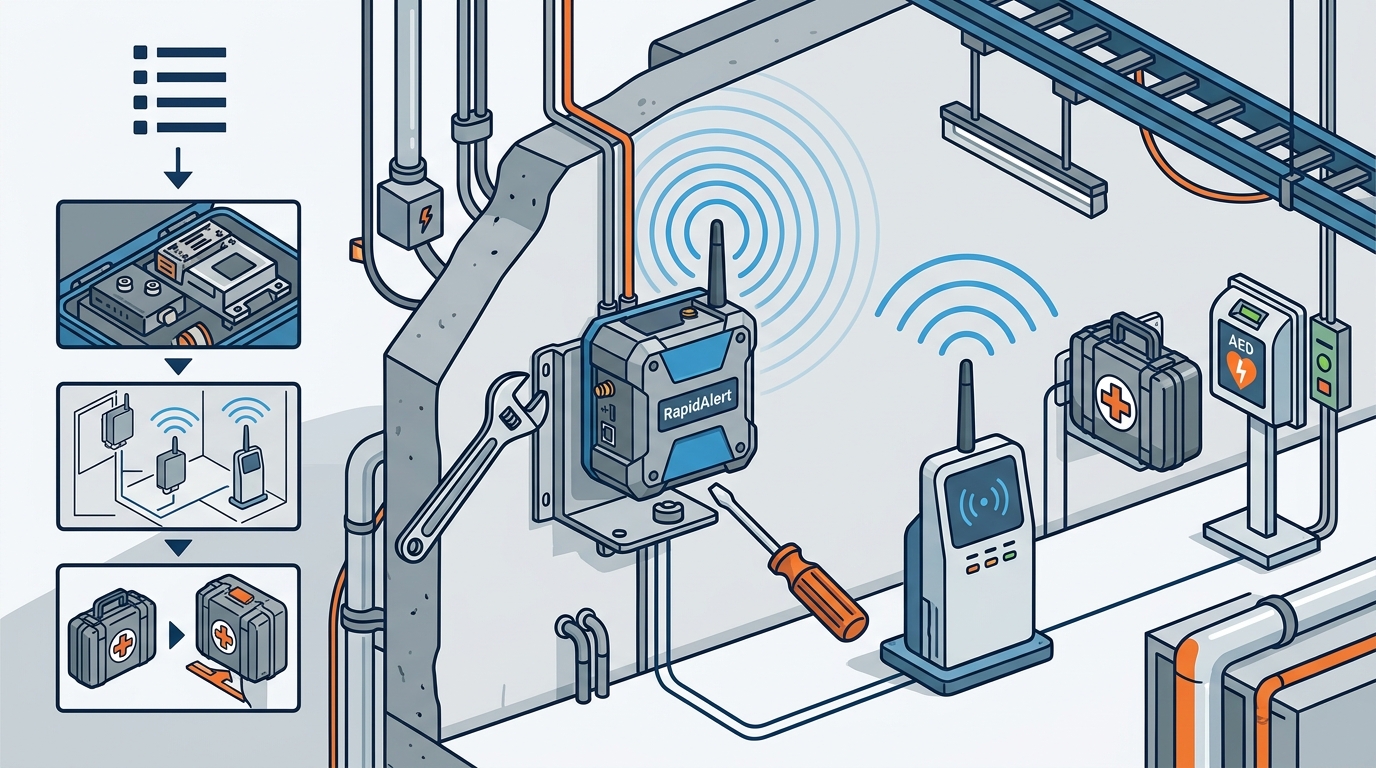
Wireless emergency systems are communication networks that transmit alert data via cellular or radio frequencies rather than physical wires. For manufacturing plants, wireless technology eliminates the cost and disruption of running cables through production floors. BluePoint Alert Solutions utilizes a cellular dual SIM primary communication pathway for the RapidAlert system. This ensures that alerts are transmitted even if the primary building network fails.
Communication Redundancy and Failover
Reliability is the cornerstone of any life-safety system. The RapidAlert system is supervised for communication trouble. If the primary cellular connection is lost, the system can utilize optional wired ethernet or redundant pathways. This redundancy is critical in industrial environments where Wi-Fi or LAN connections may be unstable due to interference from heavy machinery. The system ensures that the alert reaches the Command & Control platform regardless of local network conditions.
Integration with Command & Control
When a RapidAlert unit is activated, it connects to the BluePoint Command & Control (C2) platform. This platform orchestrates on-site communication and delivers real-time situational awareness. It provides live maps and floor plans to responders. The C2 platform also connects directly to PSAP dispatch, ensuring that professional responders arrive with context, not just an alarm signal. This integration transforms a simple pull station into a coordinated response hub.
| Feature | Traditional Wired System | BluePoint RapidAlert (Wireless) |
|---|---|---|
| Installation Labor | Licensed Contractor Required | Self-Installed by EHS Team |
| Power Source | Hardwired Electrical | Plug-in Transformer with Battery Backup |
| Communication | Single Pathway (LAN/Wi-Fi) | Cellular Dual SIM with Ethernet Option |
| Deployment Time | Weeks to Months | Days |
| Reset Mechanism | Often Requires Technician | Key Reset by Authorized Staff |
Key Takeaways
- BluePoint RapidAlert is a self-installed system designed for EHS teams, eliminating the need for a licensed contractor.
- The device uses a plug-in transformer and integral battery backup, avoiding hardwired electrical work.
- Cellular dual SIM communication ensures alerts are transmitted even if the building network fails.
- Activation is modeled after a fire alarm pull station, requiring no training for users.
- The system integrates with the Command & Control platform for real-time mapping and PSAP dispatch.
- Wireless redundancy is critical in manufacturing plants with high electromagnetic interference.
- Self-installation allows for rapid deployment across multiple production floors or remote facilities.
Frequently Asked Questions
Can a manufacturing plant install BluePoint RapidAlert without a contractor?
Yes. The RapidAlert system is designed to be self-installed by EHS and occupational safety teams. It uses a plug-in transformer and does not require hardwired electrical work or a licensed security contractor.
What happens if the building network goes down during an emergency?
The RapidAlert system uses a cellular dual SIM primary communication pathway. This ensures that alerts are transmitted to the Command & Control platform even if the local Wi-Fi or LAN network fails.
Does the system require a smartphone app to function?
No. The system sends automated text, email, and voice communications to designated response teams. No app or login is required for the recipients to receive the alert.
How is the device reset after an activation?
The device stays latched after activation. It must be reset using a key. This ensures that only authorized personnel can clear the alarm and prevents accidental re-activation.
Can the system notify professional emergency responders?
Yes. RapidAlert units can be configured to make a dispatch request to your local public safety answering point (PSAP). This ensures that professional responders are notified with precise location and incident context.
Is the system suitable for high-noise manufacturing environments?
Yes. The system includes a strobe light that activates to alert others of the emergency location. Visual notifications are effective in high ambient noise areas where audio messaging might be missed.