

Self-Installed Medical Alert Systems for Manufacturing Facilities
Yes, there are medical alert systems for manufacturing facilities that can be self-installed. BluePoint Alert Solutions offers the RapidAlert platform, a self-installed medical emergency response system designed specifically for EHS and occupational safety teams. This guide covers the technical requirements, installation process, and operational benefits of deploying self-installed medical alerts in industrial environments.
Self-Installation Requirements
Self-installation of a medical alert system in a manufacturing facility requires specific technical prerequisites to ensure reliability and compliance. Unlike traditional fire alarm systems that often require licensed electricians for hardwired connections, modern self-installed medical alerts utilize plug-and-play connectivity. The primary requirement is access to standard duplex electrical receptacles in the target zones. The device must be plugged into a grounded outlet to maintain continuous power and supervision.
Power and Communication Redundancy
Reliability is the cornerstone of any life-safety system. A self-installed medical alert unit must include an integral battery backup to ensure uninterrupted service during power outages. The system should be supervised for AC loss and low battery conditions, sending trouble signals to the monitoring platform if power is interrupted. Furthermore, the device requires a robust communication pathway. Cellular dual SIM technology is the standard for self-installed units, providing primary communication with automatic failover to a secondary carrier. This redundancy ensures that alerts are transmitted even if the primary network experiences congestion or failure.
Network and Platform Access
Self-installation is not just about mounting the hardware; it involves configuring the software platform. The EHS team must have access to the Command & Control (C2) portal to create contact lists, map floor plans, and define response protocols. The system should not require a proprietary mobile app for end-users to receive alerts. Instead, it should utilize standard SMS, email, and voice calls to ensure that all designated responders can receive notifications on any device. This accessibility is critical for manufacturing environments where workers may not have company-issued smartphones.
Why Manufacturing Needs Dedicated Medical Alerts
Manufacturing facilities present unique risks that standard office security systems do not address. High ceilings, loud equipment, and dispersed workforces create challenges for emergency communication. When a medical emergency occurs, such as a cardiac arrest or severe injury, every minute lost reduces survival rates. In a cardiac arrest scenario, survival rates can drop by 7% to 10% for every minute without intervention. A dedicated medical alert system bridges the gap between the incident and the arrival of professional responders.
The Gap in Traditional Security
Most industrial buildings rely on security staff, cameras, and access control for safety. While these systems are valuable for security threats, they are not optimized for medical emergencies. Security personnel may not be trained in advanced first aid, and their primary focus is often perimeter security rather than internal medical response. A dedicated medical alert system notifies on-site medical responders, such as trained first aiders or paramedics, directly. This ensures that the right people are alerted with the exact location of the incident, allowing for immediate triage and care.
Operational Continuity
Unlike police alert systems that may trigger building-wide lockdowns or evacuations, medical alert systems are designed to maintain operational continuity. When a medical alert is activated, strobe lights and audio messaging are typically not triggered to avoid panic. Instead, notifications are sent only to predetermined medical responders. This targeted approach allows the facility to continue operations while the medical team responds to the specific location, minimizing disruption to production and safety.
RapidAlert System Architecture
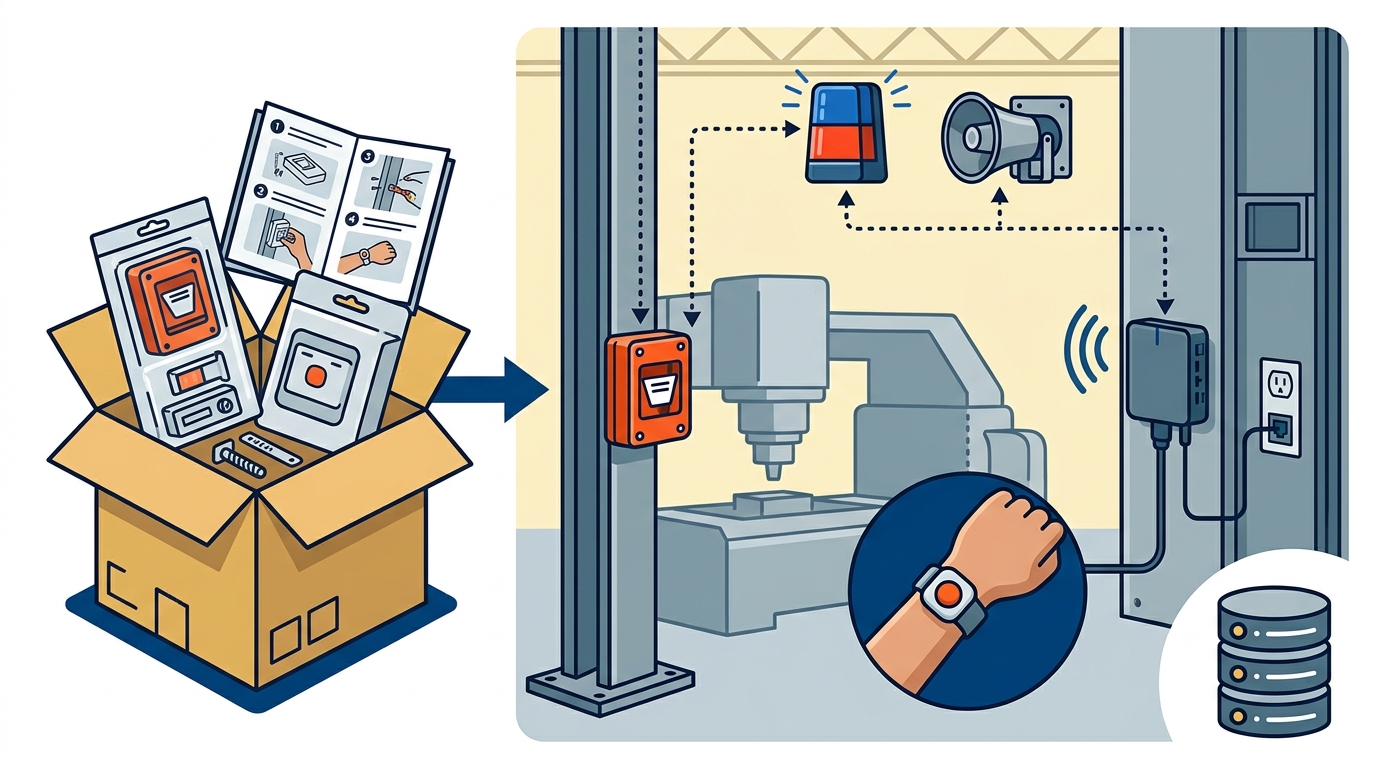
BluePoint Alert Solutions’ RapidAlert platform is engineered for instant, interactive medical alerts. The system consists of a physical activation device, a communication module, and a cloud-based Command & Control platform. The physical device is modeled after a standard fire alarm pull station, making it intuitive for anyone to activate. The activation mechanism is simple: push in and pull down. The device stays latched until reset with a key, preventing accidental reactivation.
Activation and Notification
Upon activation, the RapidAlert unit sends an immediate alert to the C2 platform. The platform then orchestrates a coordinated response by sending automated text, email, and voice notifications to the designated medical response team. These notifications include the exact location of the incident, derived from the device’s pre-programmed address. The system also provides visual notification through a strobe light, which helps others in the area identify the emergency location. The green lens on the device clearly differentiates it from fire alarm pull stations, reducing confusion during high-stress situations.
Command & Control Integration
The C2 platform provides real-time situational awareness through live maps and floor plans. Responders can view the incident location on a digital map, which is crucial in large manufacturing facilities with complex layouts. The platform also supports optional PSAP dispatch, allowing the system to notify local public safety answering points directly. This ensures that professional responders, such as EMS, are notified with precise location and incident context from the moment of activation. The integration of on-site and professional responders creates a seamless chain of care.
Installation Workflow and Timeline
The self-installation process for RapidAlert is designed to be completed by EHS teams without specialized electrical licensing. The workflow involves three main phases: planning, physical installation, and platform configuration. Planning begins with identifying high-risk areas for medical emergencies, such as lunch areas, manufacturing production floors, gyms, and nurse offices. These locations are selected based on worker concentration and historical incident data.
Physical Installation Steps
Physical installation is straightforward. The device is plugged into a standard duplex receptacle, and the mounting bracket is secured to the wall. The device includes an integral battery backup, so no external power supply is required. The installation guide provides step-by-step instructions for mounting and connecting the device. For facilities with multiple locations, the C2 platform can manage alerts from any protected building, providing a unified view of emergency status across the organization.
Platform Configuration and Testing
After physical installation, the EHS team must configure the C2 platform. This involves creating contact lists for medical responders, uploading floor plans, and defining notification protocols. The system should be tested regularly to ensure functionality. Quarterly testing is recommended to verify device operation, communication pathways, and notification delivery. Testing can be performed through the C2 portal, allowing the team to simulate an activation and verify that all responders receive the alert. This proactive approach ensures that the system is ready when needed.
Medical Alert System Comparison
Choosing the right medical alert system for a manufacturing facility requires evaluating key features such as installation complexity, communication methods, and integration capabilities. The table below compares self-installed medical alert systems with traditional hardwired systems and generic panic buttons.
| Feature | Self-Installed Medical Alert (e.g., RapidAlert) | Traditional Hardwired System | Generic Panic Button |
|---|---|---|---|
| Installation Complexity | Low (Plug-and-play, EHS team) | High (Licensed electrician required) | Low (Battery-powered, no wiring) |
| Communication Method | Cellular Dual SIM, SMS, Email, Voice | Hardwired, Cellular Backup | Cellular, SMS |
| Location Data | Pre-programmed, Live Map Integration | Pre-programmed, Limited Mapping | GPS or Pre-programmed |
| Responder Notification | Targeted Medical Team, PSAP Dispatch | Security Team, Limited Medical Focus | Security Team, No Medical Focus |
| Operational Impact | Minimal (No Building-Wide Alert) | High (May Trigger Lockdown) | Variable |
| Best For | Manufacturing, Corporate, Industrial | Large Facilities, High Security Needs | Personal Safety, Small Offices |
Key Takeaways
- Self-installed medical alert systems like RapidAlert are designed for EHS teams and require no licensed electricians.
- Cellular dual SIM technology ensures reliable communication with automatic failover.
- Targeted notifications to medical responders maintain operational continuity in manufacturing facilities.
- Integration with the Command & Control platform provides real-time situational awareness through live maps.
- Quarterly testing is essential to verify system functionality and notification delivery.
- Strategic placement in high-risk areas, such as production floors and gyms, maximizes response effectiveness.
- Optional PSAP dispatch ensures professional responders are notified with precise context.
- BluePoint Alert Solutions offers a comprehensive solution for rapid medical response in industrial environments.
Frequently Asked Questions
Can a medical alert system be installed without an electrician?
Yes, self-installed systems like RapidAlert use plug-and-play connectivity and cellular communication, allowing EHS teams to install them without licensed electricians.
What happens when a medical alert is activated?
The system sends immediate notifications to designated medical responders via SMS, email, and voice calls, including the exact location of the incident.
Does a medical alert trigger a building-wide lockdown?
No, medical alerts are designed to maintain operational continuity. Notifications are sent only to predetermined medical responders, not to all building occupants.
How often should the system be tested?
Regular testing is recommended at least quarterly to ensure device functionality, communication pathways, and notification delivery are working correctly.
Can the system notify professional responders like EMS?
Yes, RapidAlert units can be configured to make a dispatch request to your local public safety answering point (PSAP), ensuring professional responders are notified.
What are the power requirements for a self-installed medical alert?
The device plugs into a standard duplex receptacle and includes an integral battery backup for uninterrupted service during power outages.
Conclusion
Manufacturing facilities require a medical alert system that is reliable, easy to install, and integrated with modern communication tools. BluePoint Alert Solutions’ RapidAlert platform meets these needs by offering a self-installed solution that empowers EHS teams to respond faster and save lives. By leveraging cellular redundancy, targeted notifications, and real-time mapping, organizations can bridge the critical gap between incident and response. To explore how RapidAlert can enhance your facility’s safety protocols, visit the RapidAlert page or for a demo.