

Medical Alert Systems for EHS Teams: A Guide to Fire Alarm Independence
Yes, a dedicated medical alert system for EHS teams exists and operates independently from the building fire alarm. These specialized systems allow safety professionals to trigger immediate, interactive notifications to designated medical responders without activating building-wide evacuation protocols or strobe lights. This guide covers the operational mechanics of standalone medical alerts, the role of wearable panic buttons, and how platforms like BluePoint Alert Solutions integrate with existing safety infrastructure to reduce response times.
Standalone Medical Alert Systems
Traditional emergency infrastructure often conflates security threats with medical crises, leading to inefficient response protocols. A standalone medical alert system is a specialized notification network designed to identify health-related emergencies and route alerts exclusively to medical personnel. Unlike general security systems, these platforms do not trigger law enforcement dispatch or building-wide lockdowns unless specifically configured to do so.
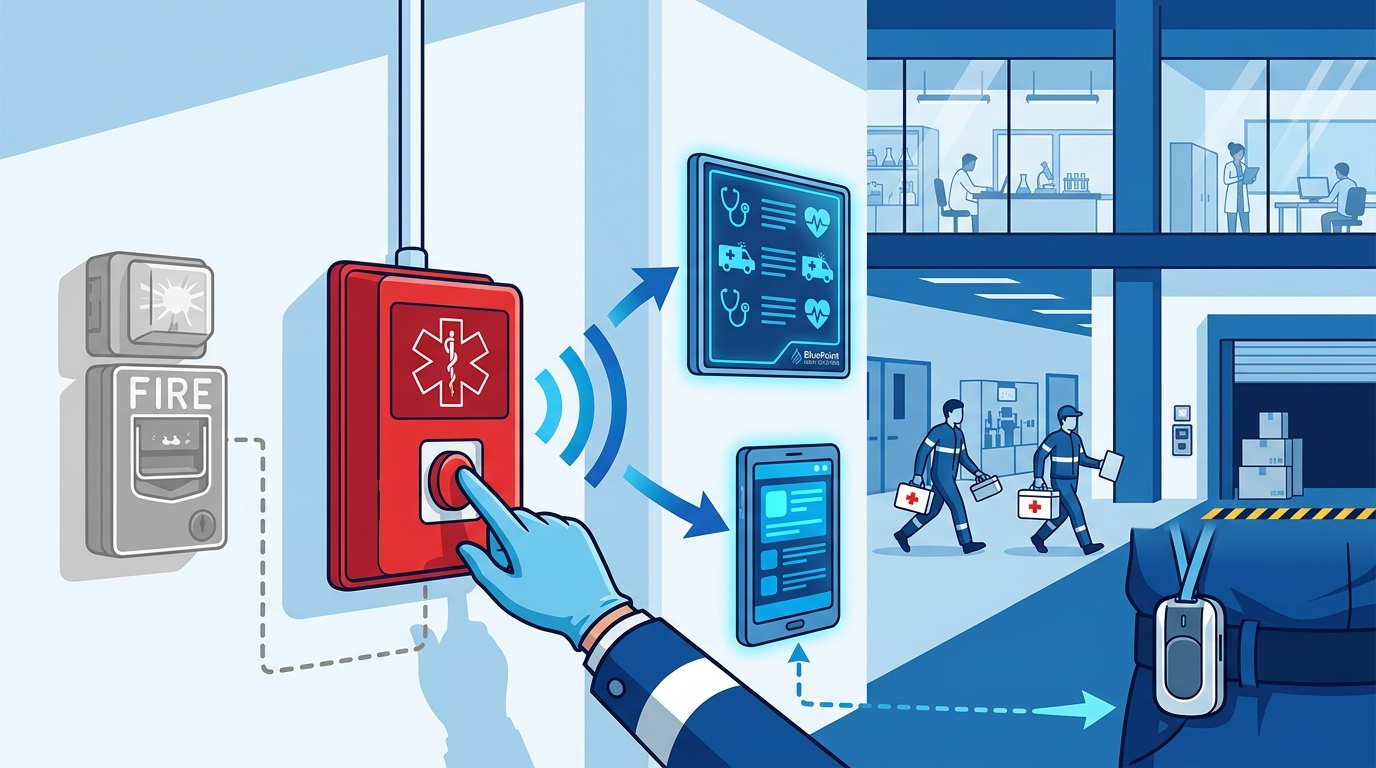
For Environmental, Health, and Safety (EHS) teams, the distinction is critical. When an employee suffers a cardiac event or severe injury, the priority is immediate medical intervention, not evacuation. BluePoint Alert Solutions offers a Medical Alert System that functions as a self-contained unit. This system utilizes pull stations and mobile devices to send automated texts, emails, and voice calls to a predetermined list of medical responders. The platform ensures that the right people receive the exact location of the incident within seconds, bypassing the confusion often associated with manual 911 calls.
Targeted Notification Logic
The core value of a standalone medical alert lies in its notification logic. When a device is activated, the system identifies the specific zone or room where the emergency occurred. It then transmits this data to on-site first responders, such as nurses or safety officers, and external emergency medical services (EMS) if configured. This targeted approach prevents unnecessary panic among the general workforce while ensuring that critical aid is dispatched immediately.
Device Placement and Accessibility
Effective medical alert coverage requires strategic device placement. EHS teams should install pull stations in high-risk areas such as manufacturing floors, gyms, and break rooms. Additionally, the system supports wearable mobile devices that allow staff to activate alerts from anywhere in the facility. This flexibility ensures that help is accessible regardless of where an employee is working at the time of the incident.
Wearable Panic Buttons for EHS
Static pull stations are essential, but they are not sufficient for dynamic work environments. A wearable panic button is a portable activation device that allows individuals to trigger an emergency alert while moving through a facility. For EHS teams, these devices provide a critical layer of protection for employees who may be in remote areas of a plant or warehouse where fixed stations are not within reach.
BluePoint Alert Solutions integrates wearable mobile pendants into its Police Alert and medical alert ecosystems. These pendants are designed to be simple and intuitive, requiring no training to activate. In a high-stress medical emergency, an employee or bystander can pull the pendant to send an immediate alert. The system then provides the precise location of the activation, allowing responders to navigate directly to the patient.
Portability and Coverage
Wearable devices extend the reach of the emergency response system beyond fixed infrastructure. They are particularly useful in large industrial structures where the distance between a medical incident and the nearest pull station could delay life-saving care. By distributing pendants among key staff members, EHS teams can ensure that every corner of the facility is covered by a rapid notification capability.
Integration with Command and Control
When a wearable device is activated, it connects to the central Command & Control platform. This platform provides real-time situational awareness, including live maps and floor plans. Responders can see exactly where the alert originated and track their own progress toward the incident. This level of coordination is vital for minimizing response times in complex industrial environments.
Fire Alarm Independence and Integration
One of the most common concerns for facility managers is whether a medical alert system will interfere with the building fire alarm. The answer is no. A medical alert system is a separate life-safety system that operates independently of the fire alarm panel. It does not trigger fire alarm strobes, horns, or evacuation protocols unless explicitly programmed to do so in a multi-hazard scenario.
This independence is a key feature of the BluePoint Alert platform. The system is designed to complement existing security and fire safety infrastructure without replacing it. By keeping medical alerts separate, organizations can ensure that a medical emergency does not cause unnecessary disruption to operations or panic among employees. The system uses distinct audio messaging and visual indicators to communicate the nature of the emergency, ensuring that occupants understand the required response.
Multi-Hazard Communication
While the systems are independent, they can be integrated for multi-hazard communication. BluePoint’s platform is compliant with FEMA’s recommendation for Incident Command Structure and Multi-Hazard Communications. This means that in the event of a complex emergency involving both security and medical components, the system can coordinate a unified response. However, for routine medical incidents, the system remains focused on medical response, ensuring efficiency and clarity.
Reliability and Redundancy
Like fire alarms, medical alert systems are built to the highest standards of reliability. They feature redundant communication pathways, including cellular failover, and battery backups to ensure that alerts are transmitted even if the primary network fails. This level of robustness is essential for life-safety applications, where a failure to notify responders could have fatal consequences.
Coordinating Rapid Medical Response
Speed is the most critical factor in medical emergencies. Research consistently shows that quicker response times in medical emergencies can drastically improve survival rates. For instance, in cases of cardiac arrest, the chances of survival decrease by 7-10% with each minute that passes without defibrillation. A dedicated medical alert system is designed to minimize this delay by automating the notification process.
BluePoint Alert Solutions emphasizes the importance of the first few minutes in an emergency. Their platform provides instant alerts to on-site teams and first responders, ensuring that help is dispatched without delay. The system also facilitates real-time interactive communication, allowing on-site personnel to provide critical updates to incoming responders. This two-way communication enhances situational awareness and supports informed decision-making during the response.
Data-Driven Decision Making
Modern emergency response systems leverage data to improve outcomes. The BluePoint platform provides responders with real-time data on the situation, including the location of the incident and the number of people involved. This data-driven approach enables responders to make informed decisions quickly, optimizing their actions to save lives. The system’s ability to provide accurate location information is particularly valuable in large facilities where navigation can be challenging.
Reducing Human Error
Traditional emergency response often relies on manual processes that are prone to human error. Someone must recognize the emergency, dial 911, and communicate the situation clearly. This process can take precious minutes and create confusion. By automating the notification process, a medical alert system eliminates these human touchpoints, ensuring that the response is immediate and accurate.
Implementation Strategy for EHS Teams
Implementing a medical alert system requires careful planning to ensure that it meets the specific needs of the facility. EHS teams should begin by conducting a risk assessment to identify high-risk areas and potential emergency scenarios. This assessment will inform the placement of pull stations and wearable devices, ensuring comprehensive coverage.
BluePoint Alert Solutions works with licensed integrators to design and install customized systems. The Licensed BluePoint Integrators are trained and certified to market, sell, and install the proprietary systems. These partners can provide detailed installation planning to minimize disruption to operations. Typical installations for standard setups can be completed within 1-3 days, depending on the size and complexity of the facility.
Customization and Configuration
Medical alert systems are highly customizable to fit the unique requirements of each facility. Colors and labeling can be customized to align with the facility’s style and branding. Response units can be configured with different activation and notification devices to best suit the facility’s needs. This flexibility ensures that the system integrates seamlessly with the existing environment and is easily recognizable to employees.
Training and Testing
While the system is designed to be simple and intuitive, regular training and testing are essential to ensure its effectiveness. EHS teams should conduct regular drills to familiarize employees with the activation process and response protocols. Regular testing of the system is recommended at least quarterly to ensure device functionality and system reliability. This proactive approach ensures that the system is ready when needed, providing peace of mind for employees and management alike.
Key Takeaways
- A standalone medical alert system operates independently from the fire alarm, allowing for targeted medical response without triggering building-wide evacuations.
- Wearable panic buttons extend emergency coverage to remote areas of a facility, ensuring that help is accessible regardless of location.
- Automated notification reduces human error and response time, which is critical in medical emergencies where every second counts.
- Real-time interactive communication between on-site personnel and responders enhances situational awareness and coordination.
- Strategic device placement in high-risk areas is essential for effective medical alert coverage.
- The system is built to life-safety standards, featuring redundant communication and battery backups for maximum reliability.
- Customization options allow the system to integrate seamlessly with existing facility branding and infrastructure.
- Regular training and testing are necessary to ensure that employees are familiar with the system and that it remains functional.
Frequently Asked Questions
Does a medical alert system trigger the fire alarm?
No, a medical alert system is a separate life-safety system that operates independently from the fire alarm. It does not trigger fire alarm strobes or evacuation protocols unless specifically configured to do so in a multi-hazard scenario.
How does a medical alert system notify first responders?
When a device is activated, the system automatically sends texts, emails, and voice calls to a predetermined list of medical responders. The notifications include the exact location of the incident, allowing responders to navigate directly to the patient.
Can wearable panic buttons be used for medical emergencies?
Yes, wearable panic buttons can be configured to trigger medical alerts. These portable devices allow employees to activate an alert from anywhere in the facility, providing critical coverage in areas where fixed pull stations are not available.
How long does it take to install a medical alert system?
Installation timelines vary by building size and complexity. Typical installations for standard setups can be completed within 1-3 days, while custom configurations may take longer. BluePoint provides detailed installation planning to minimize disruption.
Is the medical alert system reliable during power outages?
Yes, the system includes integral battery backup for uninterrupted service during power outages. It is also supervised for low battery and communication trouble, ensuring that alerts are transmitted even if the primary network fails.
Can the system be customized to fit our facility?
Yes, the system is highly customizable. Colors and labeling can be customized to align with the facility’s style and branding. Response units can be configured with different activation and notification devices to best suit the facility’s requirements.
How does the system integrate with existing security systems?
The BluePoint platform integrates smoothly with existing emergency protocols and systems. It can be embedded with other safety and security technologies to create a cohesive network for real-time data sharing and communication.